
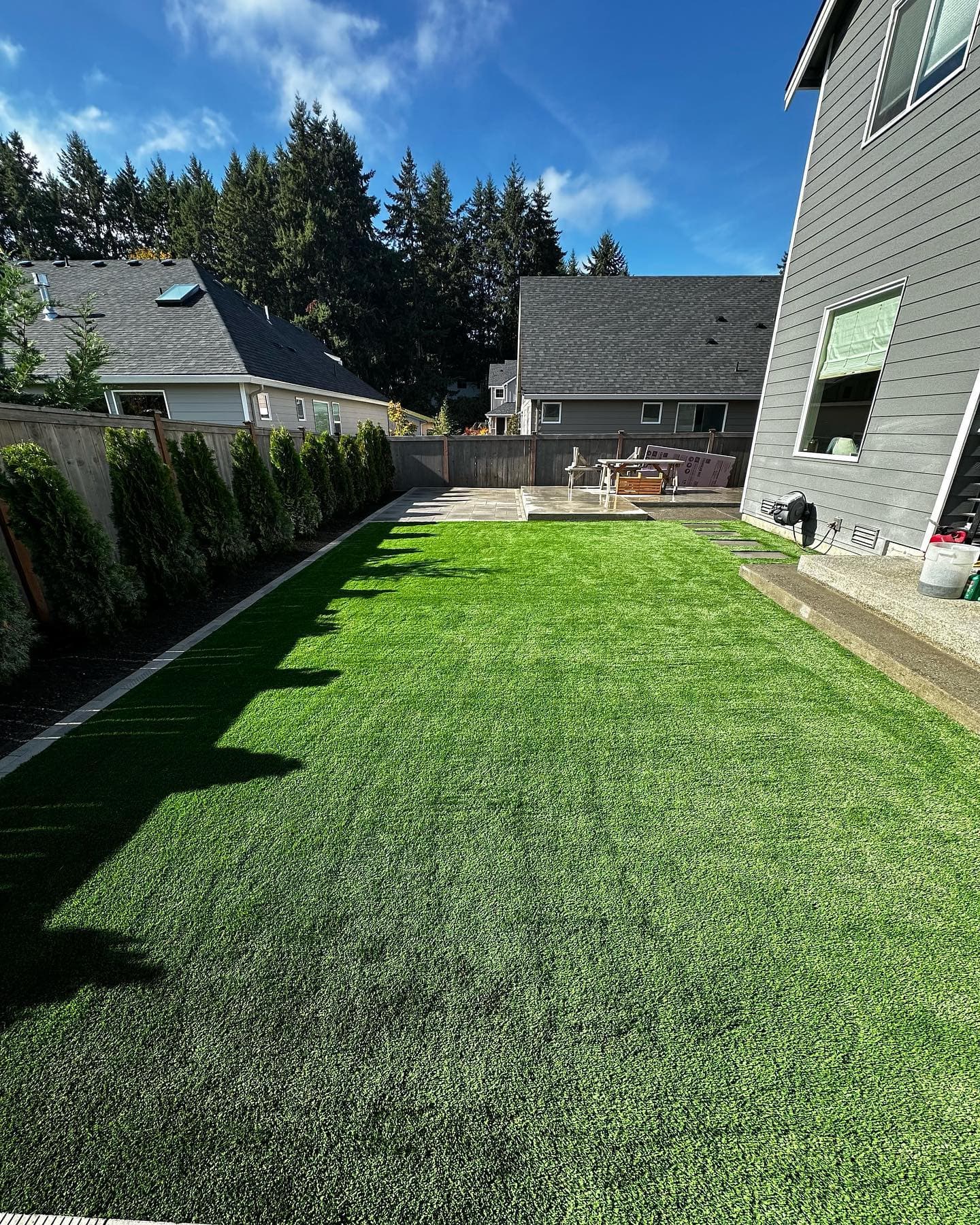
Artificial turf works in Tacoma's wet climate when the base drains faster than the rain arrives and the ground below can take the water. The City of Tacoma treats turf as a pervious lawn area, not a hard surface, and installing it counts as land disturbing activity under its stormwater manual. ND Brick Pavers builds every turf base from a free soil test.
Most turf advice online is written for Arizona, Texas, and Southern California, where the job is to keep turf cool and save water. Around Tacoma, the job is different. It is about getting about 39 inches of rain a year out of the yard without turning the base into a sponge, and dealing with shade, needles, and moss. That is what this page covers.
How does the City of Tacoma treat artificial turf?
Tacoma has a dedicated artificial turf tip sheet (S-255), and it is about stormwater, not looks. It was written against the 2021 Stormwater Management Manual. The 2026 manual applies to applications submitted on or after July 1, 2026, so confirm these points with the city for a current project. The key points:
- Turf is a lawn area. The city treats artificial turf as a lawn area under the stormwater manual's definition.
- Turf is a pollution-generating pervious surface. It is classed as pervious, not impervious.
- Installing turf is a land disturbing activity. Minimum Requirements 1 through 5 apply to new development and redevelopment with land disturbing activity of 7,000 square feet or more.
- Minimum Requirements 6 through 9 likely do not apply to the turf area. That is the tip sheet's wording. The larger project can still trigger them, for example by converting three-quarters of an acre or more of vegetation to lawn or landscaping.
- The soil amendment rule is waived for turf. The manual's post-construction soil quality BMP (L613) normally applies to pervious areas, but the city says it will not require it for artificial turf because it is not practical.
- Underdrains have to be accounted for. If turf underdrains connect to a stormwater facility or conveyance system, that system must be sized for all flows, including the underdrain.
So for a typical backyard under 7,000 square feet that is not part of a larger project, turf is not a stormwater event. For a big lot, a full-yard conversion, or a project combined with new hard surface, it can be.
Does artificial turf need a permit in Tacoma?
The city's turf tip sheet does not say a permit is required for turf by itself. Tacoma's general permit list is where the triggers live. A site development permit is required for grading or fill of more than 50 cubic yards, new or replaced hard surface of 2,000 square feet or more, or disturbance of 7,000 square feet or more. Grading exemptions also do not apply in a critical area.
A turf install removes and imports a lot of material. Excavating sod and topsoil and bringing in aggregate base across a large yard can approach the 50 cubic yard grading line. If an underdrain connects to the city's storm system, that connection is a utility permit question too. We estimate volumes during the site visit so this is known before the estimate.
Why does turf drainage matter more around Tacoma?
Turf fails here for the same reason pavers and lawns fail here: water. NOAA's 1991 to 2020 normals for Sea-Tac show about 39 inches of rain a year, with roughly three quarters of it falling from October through March. November averages over 6 inches. July averages well under 1 inch.
Water goes through turf easily. The problem is what happens next. Much of the Puget Lowland sits on glacial till, which a USGS report describes as dense "hardpan" in its lower layers, with a permeability far lower than outwash sand. Rain passes through the turf, through the base, and then stops on a subgrade that cannot take it. The base stays saturated for weeks.
That shows up as:
- Puddling and squishy spots after a few days of steady rain.
- Odor, especially in pet areas, because the base never flushes and dries.
- Soft, uneven ground as saturated fines migrate up into the base.
- Wrinkles and seams lifting when the base shifts underneath.
None of those are turf defects. They are base defects.
What base does artificial turf need in western Washington?
The layers are similar everywhere. The design decisions are not. A turf base here is built around where the water goes:
- Excavation below the sod and organic topsoil, down to firm subgrade. Leaving organic soil under the base is how turf ends up lumpy in a year.
- Subgrade check. We look at whether the subgrade is till, clay, or free-draining gravel. This is the free soil test, and it changes the rest of the design.
- Separation fabric where fine soil could pump up into the base.
- Compacted, free-draining aggregate base, deeper on slow soils so it can hold water while it soaks in.
- Underdrain on sites where the soil cannot keep up, daylighted or tied to an approved outlet.
- Fine leveling layer, compacted to a smooth finished grade with a slight pitch so surface water moves.
- Secure edges at beds, patios, and walls, so the turf is anchored and water cannot run under the edge.
Grade matters as much as depth. Turf laid dead flat on slow soil holds water. A gentle slope to a drain or a planting bed lets the surface shed the heaviest storms.
Is artificial turf a good idea for dogs in a rainy climate?
Often yes, and the rain helps. For much of the year, regular rainfall rinses the surface, which is more than dog owners in dry climates get. The weak period is late summer, when there is little rain and urine can build up in the base and infill.
What makes a dog area work:
- A base that drains freely so urine is flushed through instead of held.
- An infill suited to pets, and enough of it to keep the fibers upright.
- A hose bib within reach for summer rinsing, plus an enzyme cleaner when odor shows up.
- Solid waste picked up promptly, which is easier on turf than on wet grass.
If a turf area already smells, the base is usually the cause, not the turf. Replacing the surface without fixing the base just moves the smell to new turf.
Will moss and algae grow on artificial turf in shade?
Turf fibers are plastic and do not feed moss. Debris does. Douglas fir needles, maple leaves, and soil washed in from beds collect between the fibers, hold moisture, and become a thin growing layer. In a north-facing yard or under tall trees, moss and algae can start there by the second winter.
The fix is routine, not chemical. Blow or brush the turf every few weeks in fall and winter. Keep beds edged and set lower than the turf so mulch does not wash onto it. Trim back overhanging branches where you can. A power brush once a year lifts flattened fibers and pulls out what the blower misses.
If a yard is in deep shade most of the year, compare turf against pavers or a gravel area before deciding. Turf is not a bad choice in shade, but it is a maintenance choice.
Does artificial turf get hot in Tacoma summers?
Tacoma summers are mild. NOAA's normal average temperature at Sea-Tac in July is about 67 degrees. Even so, synthetic turf in direct afternoon sun gets noticeably warmer than live grass. For most families it is a minor issue. A quick rinse cools the surface, and placing play areas where they get afternoon shade avoids most of it.
Turf, natural lawn, or pavers for a wet, shady yard?
- Choose turf where grass will not grow because of shade, slope, or dog traffic, and where you are willing to keep debris off it.
- Choose a natural lawn where you have sun, decent soil, and you do not mind mowing and summer browning.
- Choose pavers for high-traffic areas, seating, and anywhere you need a hard, level surface. Turf and pavers often work best together, with pavers for the patio and paths and turf for the open area.
What can go wrong with a turf install, and how do you spot it?
- Seams visible from across the yard: poor seaming or a base that moved.
- Ripples after the first summer: turf not stretched and secured, or base settlement.
- Standing water after a storm: flat grade or a base sitting on soil that cannot drain.
- Edges lifting at beds: not anchored, or water running under the edge.
- Odor that does not wash out: base holding water and waste.
Most of these trace back to a thin base or a skipped soil check.
Questions to ask any turf installer
- What is under my yard, and how did you check?
- How deep is the base, and why that depth for my soil?
- Where does water go in a November storm?
- Does this project come near any City of Tacoma stormwater or grading threshold?
- How are the edges secured next to beds and pavers?
- What maintenance do you recommend in fall and winter?
How ND Brick Pavers builds turf
We run a free soil test, design the base and drainage from it, and use in-house crews for the install. If your yard is better suited to pavers, a lawn, or a mix, we will tell you that at the estimate. Our office is in Yelm, and our crews work across Tacoma and Pierce County.
Sources
- City of Tacoma: Artificial Turf tip sheet
- City of Tacoma: What Requires a Permit
- City of Tacoma: Stormwater Permits and Manuals
- NOAA NCEI: 1991-2020 monthly normals, Seattle-Tacoma International Airport
- USGS Open-File Report 00-228: Geotechnical Properties for Landslide-Prone Seattle Area Glacial Deposits
Frequently Asked Questions
Does artificial turf drain well enough for Tacoma winters?
The turf itself is not the limit. The backing is perforated or fully permeable, so water passes through quickly. What decides it is the base and the soil under the base. On dense glacial till, rain can pass through the turf and then sit on the subgrade, so wet sites need an underdrain or a deeper aggregate base sized from a soil test.
Does Tacoma count artificial turf as an impervious surface?
No. Tacoma's artificial turf tip sheet classifies turf as a lawn area and a pollution-generating pervious surface under the 2021 stormwater manual. Installing it is a land disturbing activity, so it counts toward the 7,000 square foot land disturbance threshold, and any underdrain that ties into a city system must be sized for that flow. The 2026 manual applies to applications from July 1, 2026, so confirm with the city.
Is artificial turf a good idea for dogs in a rainy climate?
It can be, if the base drains freely, because rain rinses the surface for much of the year. In the dry months, the dog area needs regular rinsing and an occasional enzyme cleaner to control odor. Ask for a base and infill designed for pets, and keep the dog run where you can reach it with a hose.
Will artificial turf get moss in a shady Tacoma yard?
Turf fibers do not feed moss, but needles, leaves, and soil that collect on the surface do. Under firs and big maples, moss and algae can start in that debris layer. Blowing or brushing the turf regularly through fall and winter, and keeping beds from washing onto it, prevents most of it.
Does artificial turf get too hot in Tacoma?
Tacoma summers are mild compared with much of the country, but any synthetic turf in direct afternoon sun gets noticeably warmer than grass. A quick rinse cools it, and light-colored or cooling infills help. Placing turf where it gets some afternoon shade is the simplest fix.
Can artificial turf go on a slope?
Yes, and on steep or eroding slopes it can be a better answer than grass that will not establish. The base has to be anchored and the edges secured so water cannot run underneath and wash the base out. A slope that sheds water onto a patio or the house needs drainage planned at the bottom.