
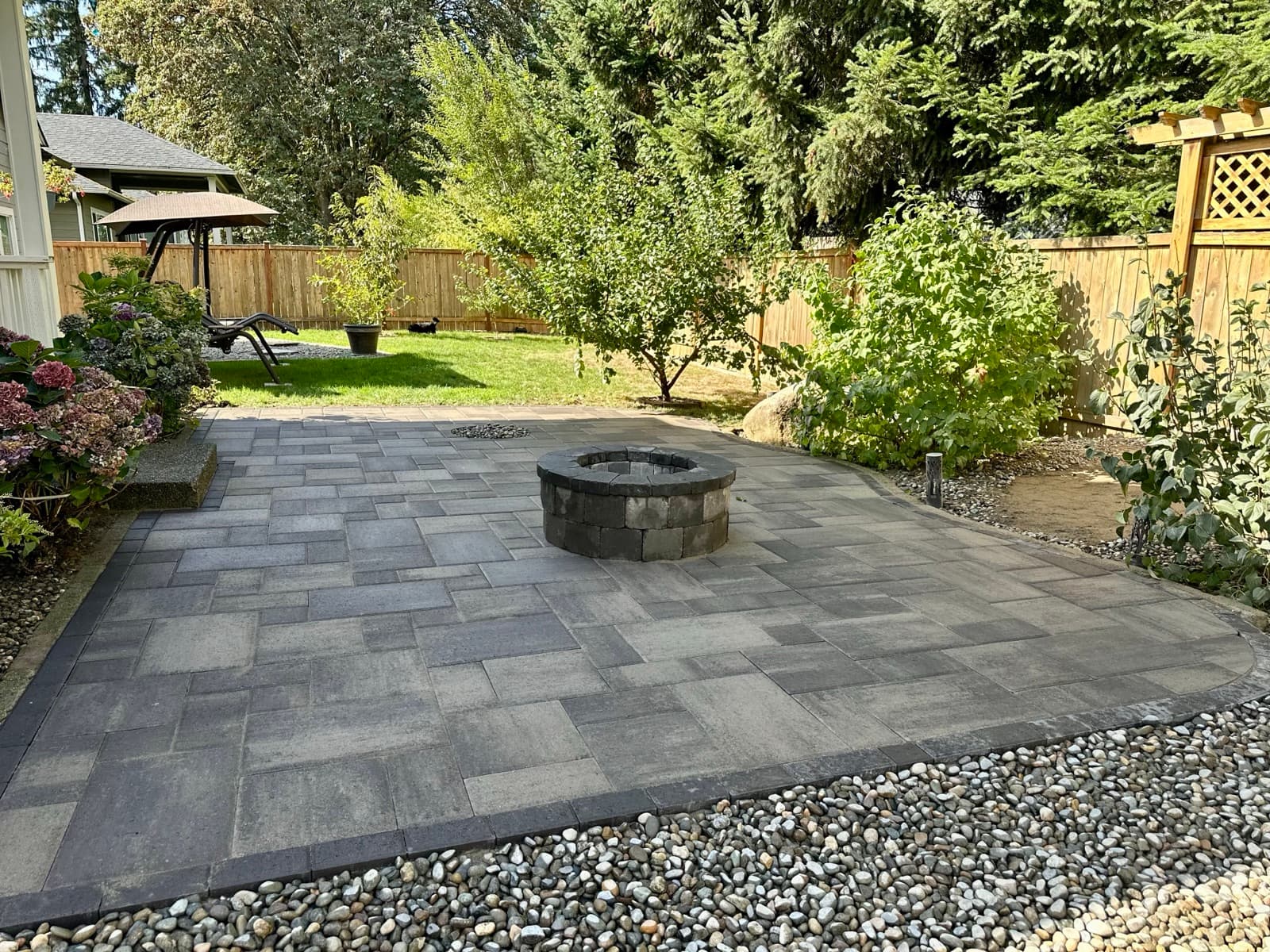
A 25-year-old driveway, replaced: one customer's project
One of our Google reviews tells a common driveway story. The homeowner's concrete driveway was about 25 years old and had started to sink and crack. They were also adding an ADU, so it made sense to replace the driveway at the same time instead of patching it.
They collected several bids. Channing West from our team worked through options with them, adding and removing items until the scope fit their budget. The crew finished the paver driveway in about two weeks, cleaned up the site at the end of every day, and hauled away the leftover material and debris when the job was done.
That pattern is typical: an older slab that settled unevenly, a second project on the property that made timing sensible, and a homeowner who wanted the scope adjusted line by line rather than a single take-it-or-leave-it number.
What goes under driveway pavers?
A driveway carries concentrated wheel loads, turning tires, and the occasional delivery truck, so it gets a heavier build than a patio. The Interlocking Concrete Pavement Institute's minimum compacted base for a residential driveway is 6 inches, versus 4 inches for patios and walks. That is the floor, not the target, on wet Tacoma soils.
ICPI's construction specification calls for pavers about 2 3/8 inches (60 mm) thick for driveways and recommends a cement- or asphalt-stabilized base over weak or saturated subgrades. Below the base, a geotextile fabric keeps clay and silt from working up into the rock. Above it sits about an inch of bedding material, then the pavers.
- Excavation deep enough for the full base, bedding, and paver thickness, below any organic soil.
- Compacted subgrade, shaped to the finished slope.
- Geotextile separation fabric on clay, silt, or till.
- Crushed angular base rock placed and compacted in lifts.
- Screeded bedding layer of about 1 inch.
- Vehicle-rated pavers, compacted into the bedding.
- A rigid edge restraint, often a buried concrete curb, along every unsupported edge.
- Joint sand swept in and compacted so the pavers lock and share load.
Why Tacoma driveways fail, and how to read the signs
Most driveway failures here start with water, not cold. NOAA's 1991-2020 normals for Sea-Tac show about 39 inches of precipitation a year, most of it from October through March. A base that sits wet all winter is weaker all winter, and that is when tires do their damage.
Many lots around Tacoma sit on glacial till, a dense, compacted soil that sheds water instead of absorbing it. Washington State University's Puget Sound low impact development manual describes till soils turning rain into surface runoff quickly. Under a driveway, that water collects on top of the till and softens the base from below.
- Ruts or dips in the wheel paths: base too thin or too soft for vehicle loads.
- Pavers spreading apart at the edges: missing or failed edge restraint.
- A low spot at the garage door that holds water: grade never set to drain away from the slab.
- Settling along a sidewalk or foundation: loose backfill under the edge was never compacted.
- Sunken areas over a trench: a utility line was buried and backfilled without compaction.
Can pavers be laid on a sloped driveway?
Yes. Pavers work well on slopes, which matters in a city with hillside lots from the North End to Northeast Tacoma. The textured surface and joints give better grip than smooth concrete, and the joints let the surface flex instead of cracking along the grade.
Steep driveways need more attention to edge restraint at the bottom, where the paver field wants to creep downhill, and to water that runs the full length of the drive and hits the garage or the street. Most installers lay vehicle areas in a herringbone pattern on slopes because the interlock resists the push of braking and turning tires. A drain across the bottom of a steep drive is often part of the design.
Where does the water go? Drainage and stormwater rules
A driveway is one of the largest hard surfaces on a lot. The design has to say where its water goes: away from the garage and foundation, not onto a neighbor's property, and into a lawn, planting area, drain line, or the street system where that is allowed.
For bigger projects, the City of Tacoma's 2021 Stormwater Management Manual can come into play. A 2022 City policy memo applies the manual's first five minimum requirements to redevelopment that creates 2,000 square feet or more of new plus replaced hard surface, or disturbs 7,000 square feet or more of land. A long driveway replacement plus a widened parking pad can approach that threshold, so we check it at the design stage.
Permeable pavers are one way to handle water on site. Their open joints let rain pass into a deep stone reservoir below. They are not right for every soil, and on dense till the reservoir may need an underdrain. We cover them as a separate service.
Permits and the part of the driveway the City owns
Replacing a private driveway surface on your own lot is mostly a construction question, but two edges are not. The apron where the driveway meets the street, plus any sidewalk or planting strip it crosses, is usually public right-of-way. The City of Tacoma defines right-of-way to include sidewalks and planting strips, and work there needs City approval.
Retaining walls beside a driveway are the other trigger. The City of Tacoma's permit exemption for walls up to 4 feet does not apply to a wall that supports a surcharge from a driveway. If your driveway project needs a wall to hold the driveway's edge, plan on a permit and confirm the details with the City. Before any digging, Washington law requires an 811 utility locate request at least two business days in advance.
Paver driveway vs. concrete vs. asphalt in the Northwest
Asphalt is the lowest-cost hard driveway to install in most cases. It needs periodic sealcoating, softens in heat, and edges crumble without a solid border. Poured concrete costs more than asphalt, looks clean, and cracks when the ground moves. Repairs on either show.
Pavers usually cost the most to install. What you get is a surface you can take apart: a sunken corner or a buried line can be fixed by lifting that section and relaying the same pavers. Oil stains and broken units can be replaced one at a time. On ground that moves with the seasons, that repairability is the main reason people choose pavers.
What drives the cost of a paver driveway
We do not post prices because driveways vary too much. Size is only one input. The bigger swings come from the work below the surface and around the edges.
- Demolition and haul-off of existing concrete or asphalt, including thickness and any rebar.
- Soil condition and base depth, including stabilized base where the ground is soft.
- Slope, and whether walls, steps, or drains are needed.
- Access for excavators and dump trucks, especially on narrow or alley-loaded lots.
- Paver product, thickness, pattern, and border details.
- Drainage work: trench drains, downspout tie-ins, or a permeable section.
- Permits for right-of-way work or walls, where they apply.
How ND Brick Pavers handles a driveway replacement
We start with a free site visit and soil test, then a free 3D design showing the layout, pattern, and border on your actual driveway. The itemized proposal lets you add or drop options the same way the homeowner above did, so the scope fits the budget before work is scheduled.
Our in-house crews do demolition, base work, installation, and cleanup, with no subcontractors. Driveway crews travel from our Yelm office to jobs across Tacoma and Pierce County, and the company holds a 4.7 Google rating.
Sources
- CMHA (formerly ICPI) Tech Note PAV-TEC-002-22, Construction of Interlocking Concrete Pavements (6-inch minimum base for residential driveways, stabilized bases)
- CMHA (formerly ICPI) Tech Note PAV-TEC-010-22, Application Guide for Interlocking Concrete Pavements (paver thickness for driveways)
- NOAA NCEI, 1991-2020 Climate Normals, Seattle-Tacoma Intl Airport (USW00024233), monthly precipitation
- WSU Extension and Puget Sound Partnership, Low Impact Development Technical Guidance Manual for Puget Sound (2012)
- City of Tacoma Policy Memo ESD22-02, 2021 SWMM Redevelopment Minimum Requirements Thresholds
- City of Tacoma Planning and Development Services, FAQs (right-of-way, retaining walls)
- WA Utilities and Transportation Commission, Call before you dig: it is the law