
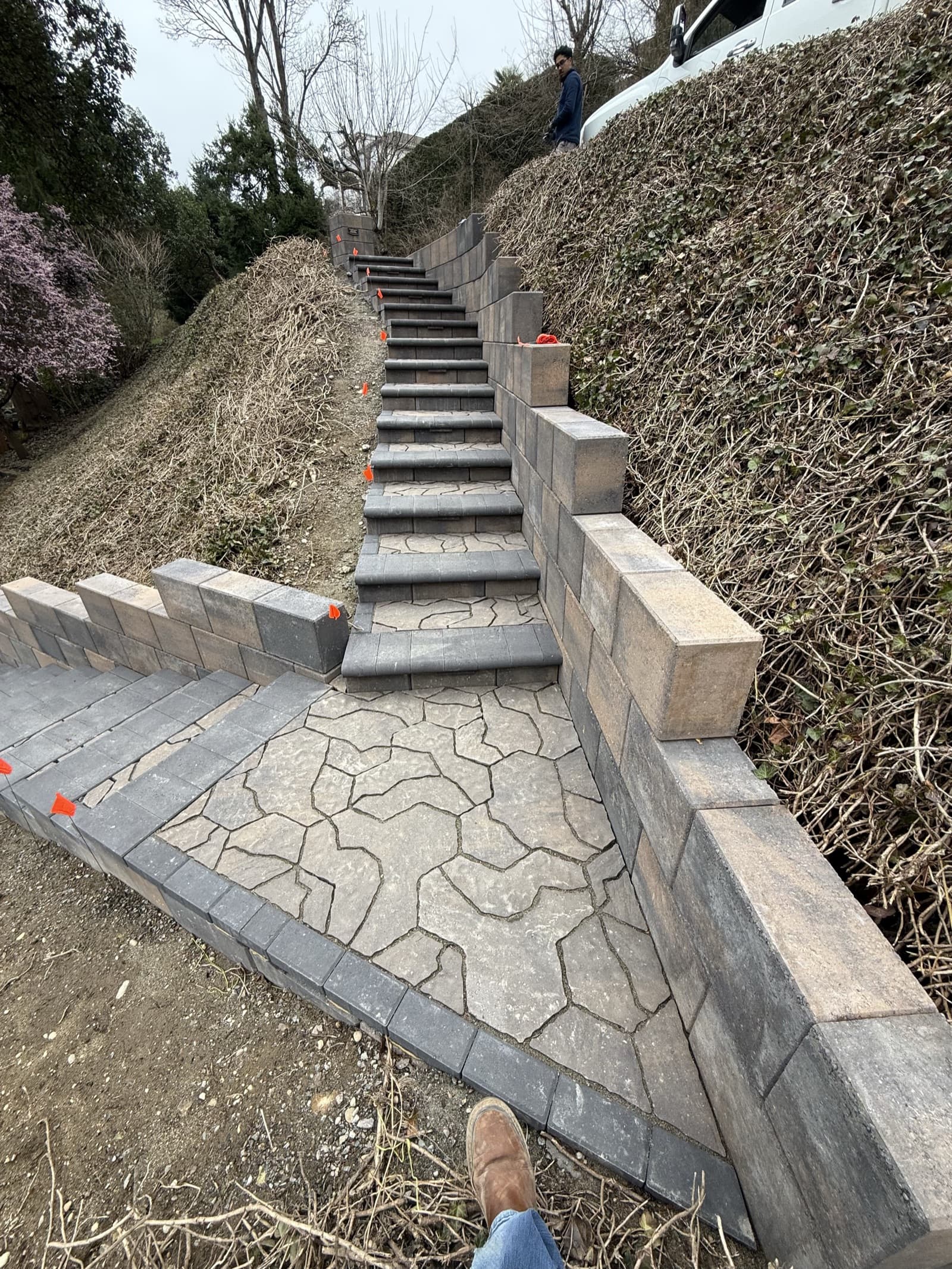
In western Washington, the best time to install pavers is late spring through early fall, when the subgrade is driest and joint sand can cure. NOAA normals show July at Sea-Tac averages 0.60 inches of rain, against more than 6 inches in November. Winter work is possible on well-drained sites with care. ND Brick Pavers schedules every project from a soil test.
People ask me when to build a patio because they have heard you cannot do hardscape here in winter. That is half true. Rain does not stop us from working. It stops us from doing certain steps, and the contractors who ignore that are the ones whose patios settle the next spring. This guide explains what the season actually changes and how to plan around it.
When is the best time of year to install pavers in western Washington?
The calendar follows the rain. These are NOAA's 1991 to 2020 monthly precipitation normals for Seattle-Tacoma International Airport, the long-term station closest to most of our Pierce County work:
| Month | Normal rainfall (inches) | Normal average temp (F) |
|---|---|---|
| January | 5.78 | 42.8 |
| February | 3.76 | 44.0 |
| March | 4.17 | 47.1 |
| April | 3.18 | 51.3 |
| May | 1.88 | 57.5 |
| June | 1.45 | 62.0 |
| July | 0.60 | 67.1 |
| August | 0.97 | 67.4 |
| September | 1.61 | 62.6 |
| October | 3.91 | 53.8 |
| November | 6.31 | 46.5 |
| December | 5.72 | 42.0 |
The annual total is about 39 inches. October through March carries roughly three quarters of it. May through September is the dry window, and July and August are the driest months of the year.
That makes May through September the prime build season, with late April and early October as good shoulder months in a dry year.
Why does rain matter so much for paver base work?
A paver surface is only as good as what is under it, and compaction is the step rain affects most.
Soil compacts best at a moderate moisture content. Too wet and the water fills the spaces between particles, so the compactor squeezes water around instead of pushing particles together. On clay and glacial till, that shows up as pumping: the ground ripples and water rises under the plate. A base compacted over pumping subgrade feels firm on day one and settles in the first wet season.
The other problem is fines migration. When saturated clay or silt sits directly under an aggregate base, traffic and water push the fine particles up into the rock. Over time the base loses its strength and drainage. Separation fabric helps, but it does not fix a subgrade that was soft when the base went in.
Our region makes this worse. Much of the Puget Lowland sits on dense glacial till, which a USGS report describes as hardpan with very low permeability compared with outwash sand. Rain that soaks in sits on top of the till instead of draining away, so a site can stay wet long after the sky clears.
What paver work can be done in winter?
More than people expect, as long as the crew is honest about when to stop.
- Site visits, soil tests, and design. The best time to see how a yard handles water is during a storm.
- Permits. If a wall, a curb cut, or a large area needs a permit, winter is the time to file it.
- Demolition of old concrete or a failed patio, with the area protected afterward.
- Excavation on free-draining soils, when the dig can be followed quickly by base and covered.
- Drainage work: drain lines, catch basins, downspout tightlines. These often make more sense to install when you can see where the water goes.
- Retaining wall drainage and base courses on suitable days, with the excavation protected from runoff.
- Repairs like lifting and relaying a sunken section, on dry days between storms.
What should wait for dry weather?
- Compacting the subgrade and base on clay or till while it is saturated.
- Polymeric joint sand. One major manufacturer, Alliance Gator, specifies a dry surface, no rain in the forecast within one hour on a drainage base or within 24 hours on a non-drainage base, and a temperature of 32 degrees Fahrenheit or higher. Other brands differ, so the bag decides.
- Sealing. Sealers need a clean, dry surface and dry weather to cure.
- Large open excavations on slow soil, which fill with water and turn the subgrade to mud.
A practical schedule in the shoulder season is to dig and build base in a dry stretch, lay pavers, and leave the final joint sand for a confirmed dry window, with tarps on site.
Does freezing weather stop paver installation?
Rarely for long around Tacoma. The normal average temperature at Sea-Tac stays above freezing in every month, with December the coldest at 42 degrees. Freezing nights still happen, and when they do:
- Do not compact frozen soil or place base on frozen ground.
- Do not install polymeric sand below the manufacturer's minimum temperature.
- Watch for frost in the morning on shaded sites, which can delay the start of work.
Cold is a much smaller risk here than water. A base that drains is a base that freeze events cannot lift.
Why book in winter for a spring or summer install?
Because the paperwork and design take longer than the build. A patio that will be built in a week can easily need a few weeks of lead time before that: site visit, soil test, 3D design, material selection, permits where needed, and scheduling around other trades like gas or electrical for an outdoor kitchen.
Starting those steps in winter means your project is ready to go when the ground dries, instead of starting the process in May and building in August.
What happens if a contractor builds in the wet season without adjusting?
The failures do not show up right away. They show up the following winter:
- Low spots and birdbaths where the base settled over soft subgrade.
- Pavers rocking or shifting at edges and in traffic paths.
- Joint sand washing out or hazing, from polymeric sand installed on damp pavers or before rain.
- Rutting in a driveway where the base was compacted over pumping clay.
When you get quotes in the wet season, ask how the contractor will handle wet days. "We just work through it" is the wrong answer for base compaction.
How do permits and stormwater rules affect timing?
Wet-season work also brings erosion control into focus. In the City of Tacoma, the stormwater policy memo for the 2021 manual states that all redevelopment must comply with Minimum Requirement 2 of the stormwater manual. Ask the city what that requires for your site. On a wet-season dig, the practical goal is keeping mud on the site and out of the storm drains. Larger projects trigger a site development permit at 2,000 square feet of new or replaced hard surface, 50 cubic yards of grading, or 7,000 square feet of disturbance. Tacoma's 2026 stormwater manual applies to applications submitted on or after July 1, 2026, so confirm the current requirements when you apply.
Practically, a winter dig needs a plan for covering stockpiles, protecting nearby storm drains, and keeping the street clean. That is part of doing the job right in any season, but it matters most from October through March.
A month-by-month planning calendar
- November to February: site visit, soil test, design, budget, permits. Watch how your yard handles water.
- March to April: confirm design and materials, schedule the build, finish permits. Some well-drained sites can start in a dry stretch.
- May to June: prime start window. Ground is drying, days are long.
- July to August: driest months. Best for joint sand, sealing, and sites with clay or till.
- September: still good. Start large projects early in the month.
- October: shoulder month. Small projects and well-drained sites.
Questions to ask about scheduling
- What is my soil, and how long does it stay wet after rain?
- Which steps will you not do in the rain?
- How will the excavation be protected if a storm comes mid-project?
- When will the joint sand go in, and what is the forecast rule?
- If a permit is needed, how long will it take?
How ND Brick Pavers schedules projects
We start with a free soil test, because the soil tells us when a site is buildable. On well-drained ground we can work later into the fall and earlier in the spring. On clay or till we plan base work for the dry months and use the wet season for design and permits. Our office is in Yelm, and our crews work across Tacoma, Pierce County, and nearby Thurston County.
Sources
- NOAA NCEI: 1991-2020 monthly normals, Seattle-Tacoma International Airport
- Alliance Gator: 10-step polymeric sand installation guide
- USGS Open-File Report 00-228: Geotechnical Properties for Landslide-Prone Seattle Area Glacial Deposits
- City of Tacoma Environmental Services Policy Memo ESD22-02
- City of Tacoma: What Requires a Permit
- City of Tacoma: Stormwater Permits and Manuals
Frequently Asked Questions
Can pavers be installed in the rain?
Light rain does not stop every step, but it stops the important ones. A saturated subgrade cannot be compacted properly, and polymeric joint sand needs a dry surface and a dry forecast to set. A good crew will dig, set edge restraint, or build wall drainage in a drizzle, then wait for the base and joints to dry before compacting or sanding.
Is it cheaper to install pavers in winter?
Not reliably. Winter work on wet sites can need extra base, fabric, or drainage, and rain days stretch the schedule. What winter does offer is time: design, soil testing, permits, and material selection can all happen in the wet months so the build starts as soon as the ground dries.
How long after rain can paver base be compacted?
It depends on the soil, not the calendar. Free-draining gravel can be workable soon after rain stops. Clay and glacial till can stay too wet to compact for days or longer in the wet season. The test is on site: if the subgrade ruts, pumps water, or feels spongy under equipment, it is not ready.
Can I install pavers myself in the fall?
Early fall is often good, because the ground is still dry from summer. The risk is starting a project in late September and finishing it in late October, when the rains have returned. Plan the dig, base, and joint sand for a stretch of dry days and have tarps ready.
Does cold weather affect pavers?
Cold alone is rarely the problem around Tacoma, where average winter temperatures stay above freezing. Frozen ground should not be compacted or built on, and polymeric sand has a minimum installation temperature, commonly 32 degrees Fahrenheit or higher. Water trapped in a poorly drained base is a bigger risk than freezing.
When should I book a spring paver project?
Winter. Booking a site visit and design in December through February gives time for a soil test, a 3D design, and any permits, so the project can be scheduled for the first workable stretch of spring instead of waiting to start the paperwork when the weather turns.