
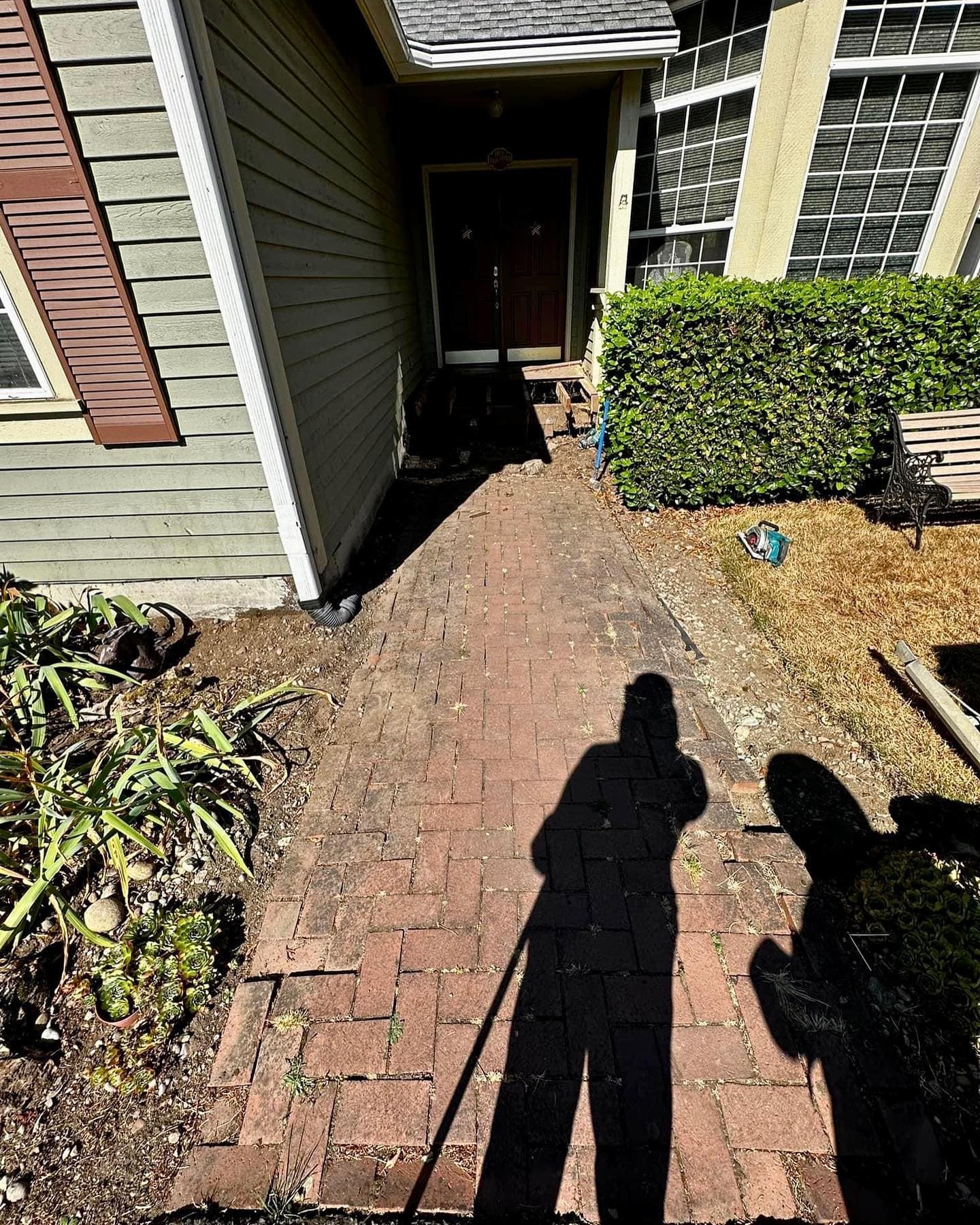
Moss grows on pavers in Western Washington because shaded surfaces stay damp for months and joints collect organic debris. Remove it by sweeping, hosing, and scrubbing, or with a product labeled for pavers, and avoid high-pressure blasting and iron sulfate, which can damage or stain pavers. ND Brick Pavers cleans, re-sands, and re-levels moss-damaged pavers across Tacoma and Pierce County.
Moss is not a sign that something is wrong with your pavers. It is a sign that a surface stays wet and shaded long enough for moss to grow, which in this region describes a lot of north-facing patios, walkways under trees, and paths beside fences. The goal is to remove it without damaging the pavers or the joints, then change the conditions so it grows back slower.
Why does moss grow on pavers in the Pacific Northwest?
Moss needs moisture and shade, and it gets both here from fall through spring. Oregon State University Extension describes moss as a shade-loving plant that does not thrive in sunny conditions and notes that it needs moisture to grow.
On a paver surface, moss shows up first where these conditions overlap:
- Shade. North sides of houses, under conifers and maples, beside fences and tall hedges.
- Slow drying. Areas with little airflow, or surfaces that never get direct sun in winter.
- Debris in the joints. Needles, leaves, and soil settle into joint lines and break down into a growing medium.
- Standing water. Low spots, flat areas, and the zone below a downspout or sprinkler overspray.
Once moss takes hold in the joints, it holds moisture against the paver edges and catches more debris, which makes the next round easier.
How do you diagnose why moss is growing where it is?
Before you clean, look at the pattern. It tells you whether you have a maintenance issue or a water issue.
| Pattern | Likely cause | What fixes it |
|---|---|---|
| Even, light moss across a shaded area | Shade and slow drying | Regular cleaning, more light and airflow |
| Moss mainly in joints, faces mostly clean | Debris and loose joint sand | Clean joints, re-sand |
| Heavy moss in one low spot | Water ponding on a settled area | Re-level the base, restore slope |
| Moss line below a downspout or along an edge | Concentrated runoff | Redirect water, check drainage |
| Moss plus rocking or sunken pavers | Wet, failing base | Lift, rebuild base, re-lay |
If moss is telling you about water, cleaning alone will buy you one season.
What is the safest way to remove moss from pavers?
Start with the gentlest method that works. OSU Extension's guidance for moss on pavement begins with physical removal: sweep debris with a stiff broom, spray moss off with a garden hose, and scrub stubborn patches with a stiff brush or lift them with a flat scraper. Because moss has no roots, mats lift off easily once they are wet.
Our sequence for a homeowner:
- Sweep loose debris off the surface.
- Wet the moss so it softens.
- Scrape or scrub the mats off the faces. A flat scraper works well on thick moss.
- Clean the joints with a joint tool, a narrow scraper, or a stiff wire brush run along the joint line. Pull out organic material, not just the green on top.
- Rinse with a hose at normal pressure.
- Let it dry, then check whether the joints need new sand.
That last step is the one most people skip. Cleaning moss out of joints usually removes some joint sand with it.
Which chemical moss treatments are safe for pavers?
If you want a chemical step, use a product labeled for patios, walkways, or pavers, and follow the label. The label is the legal instructions for that product.
A few practical notes from extension guidance and from what we see on jobs:
- Moss-control soaps (fatty-acid soaps) are a common choice on hardscape. A WSU and King County Extension column on moss notes that these soaps have a low-hazard "Caution" label and do not stain.
- Iron sulfate is common in moss products, but the same column warns that it stains concrete. Keep it off pavers, patios, and walkways. Rust-colored stains on concrete pavers are hard to remove.
- Bleach solutions are listed by OSU Extension for moss on pavement, mixed with water and detergent, left at least five minutes, and rinsed thoroughly. Never mix bleach with ammonia or other household cleaners. Bleach can also affect colored concrete pavers and nearby plants, so test first and protect plantings.
- Vinegar is another OSU-listed option. Because it is acidic, test it on a hidden paver and rinse well.
Whatever you use, keep it and the rinse water out of storm drains and away from lawns and beds you want to keep. Treat before rain only if the label says so; some products need dry time to work.
Which moss removal methods damage pavers?
These are the methods that do the most damage:
- High-pressure washing with a narrow tip, held close. It removes moss fast, and it also cuts into the surface of concrete pavers, exposing aggregate and leaving visible wand marks. It blows sand out of the joints, which loosens pavers and gives moss a fresh place to root.
- Wire brushes on the paver faces. Fine on joints, but they can scratch and polish some paver finishes.
- Iron sulfate. Staining, as noted above.
- Strong acids. Muriatic acid and similar products can etch concrete pavers and change their color. They are not moss removers.
- Rock salt or de-icers. Sometimes suggested online as a moss killer. Salt can damage concrete surfaces and nearby plants.
If you do use a pressure washer, use moderate pressure, a wide fan tip or a rotary surface cleaner, keep the tip well back from the surface, and work at an angle. Then refill the joints. The Seattle Times column from a WSU and King County Extension agent also notes that treating moss before pressure washing slows how fast it returns.
How do you keep moss from coming back on pavers?
You cannot make a shaded patio in Puyallup or a walkway under Douglas firs in Gig Harbor moss-free. You can slow it down a lot.
- Let in light and air. OSU Extension recommends trimming back trees, shrubs, and grass along edges. Even a few hours more of winter sun helps.
- Keep water off. Adjust sprinklers so they do not spray the pavers, and send downspouts to a drain or a planting area instead of across the surface.
- Sweep regularly in fall. Getting needles and leaves off before they break down removes the growing medium from the joints.
- Keep joints full and firm. Tight joints filled to the proper depth leave less space for debris and spores. In shaded areas, polymeric sand installed in a proper dry window can help.
- Fix low spots. A paver area that holds water will grow moss no matter how often you clean it.
Should moss-prone pavers be sealed?
Sealing is a reasonable step on some surfaces and a mistake on others. A sealer can make the surface easier to clean and can help stabilize joint sand. But a high-gloss film-forming sealer on a shaded, damp surface can become slick when algae and moss grow on it. On walkways and steps in shade, we generally prefer penetrating or low-sheen products, or no sealer at all.
If you do seal, the surface must be clean and fully dry first. Sealing over moss or damp joints traps the problem under the coating.
When should you call a paver contractor about moss?
Call someone when moss is the symptom, not the problem:
- Pavers are rocking, sinking, or uneven.
- Water stands on the surface after rain.
- Joint sand is gone in large areas.
- Moss returns heavily within weeks of cleaning in one specific area.
- Steps or a walkway are slick enough to be a fall risk and cleaning does not fix it.
ND Brick Pavers handles cleaning, re-sanding, sealing, and re-leveling for paver surfaces across Tacoma, Pierce County, and nearby Thurston County. If an area keeps growing moss because it holds water, we will tell you whether it needs a base repair or just better maintenance.
Sources
- Oregon State University Extension: How can I get rid of the moss on my pavement?
- The Seattle Times archive: Gather no moss, column by a WSU/King County Extension agent (2002)
Frequently Asked Questions
What kills moss on pavers without damaging them?
Start mechanical: sweep, hose, and scrub with a stiff brush or lift mats with a flat scraper, because moss has no roots and lifts easily. For chemical help, choose a product labeled for patios and pavers and test it on a hidden area first. Moss-control soaps are a common choice because they do not stain. Avoid iron sulfate on pavers, since it can leave rust-colored stains.
Should I pressure wash moss off pavers?
Pressure washing removes moss quickly, but it also blows sand out of the joints and can scar the surface of concrete pavers if the tip is too close or the pressure too high. If you use one, keep the pressure moderate, hold the wand at an angle, keep the tip well back from the surface, and plan to refill the joints afterward. A surface cleaner attachment is gentler than a bare wand.
Does vinegar kill moss on pavers?
Oregon State University Extension lists vinegar as one option for moss on pavement, applied and left for 15 to 20 minutes and repeated for about a week, then rinsed. Vinegar is an acid, and acids can etch cement-based surfaces, so test it on a hidden paver first and rinse well. It is a mild option, not a permanent fix.
Is moss on pavers harmful or just ugly?
Mostly it is a slip hazard and an appearance problem. Moss on a walkway or steps becomes slippery when wet, which is reason enough to remove it. It also traps organic debris in the joints, which can support weeds and hold moisture at the surface. Thick moss in the joints is often a sign that the area stays wet and shaded, which is worth fixing on its own.
Will sealing pavers stop moss?
Sealing can make cleaning easier and some sealers resist organic growth, but it does not stop moss on a surface that stays shaded and damp. A glossy film-forming sealer can actually become slick when algae or moss grow on it. Light, airflow, and drainage do more than any coating. If you seal, clean and dry the surface completely first so you do not trap growth under the sealer.
When is moss a sign of a bigger paver problem?
When it is concentrated in low spots, along one edge, or below a downspout. Moss tracks water. If one area grows moss heavily while the rest stays clean, that area is probably holding water because of a settled base, poor slope, or a drainage outlet that is not working. Cleaning treats the symptom; re-grading or re-leveling treats the cause.