
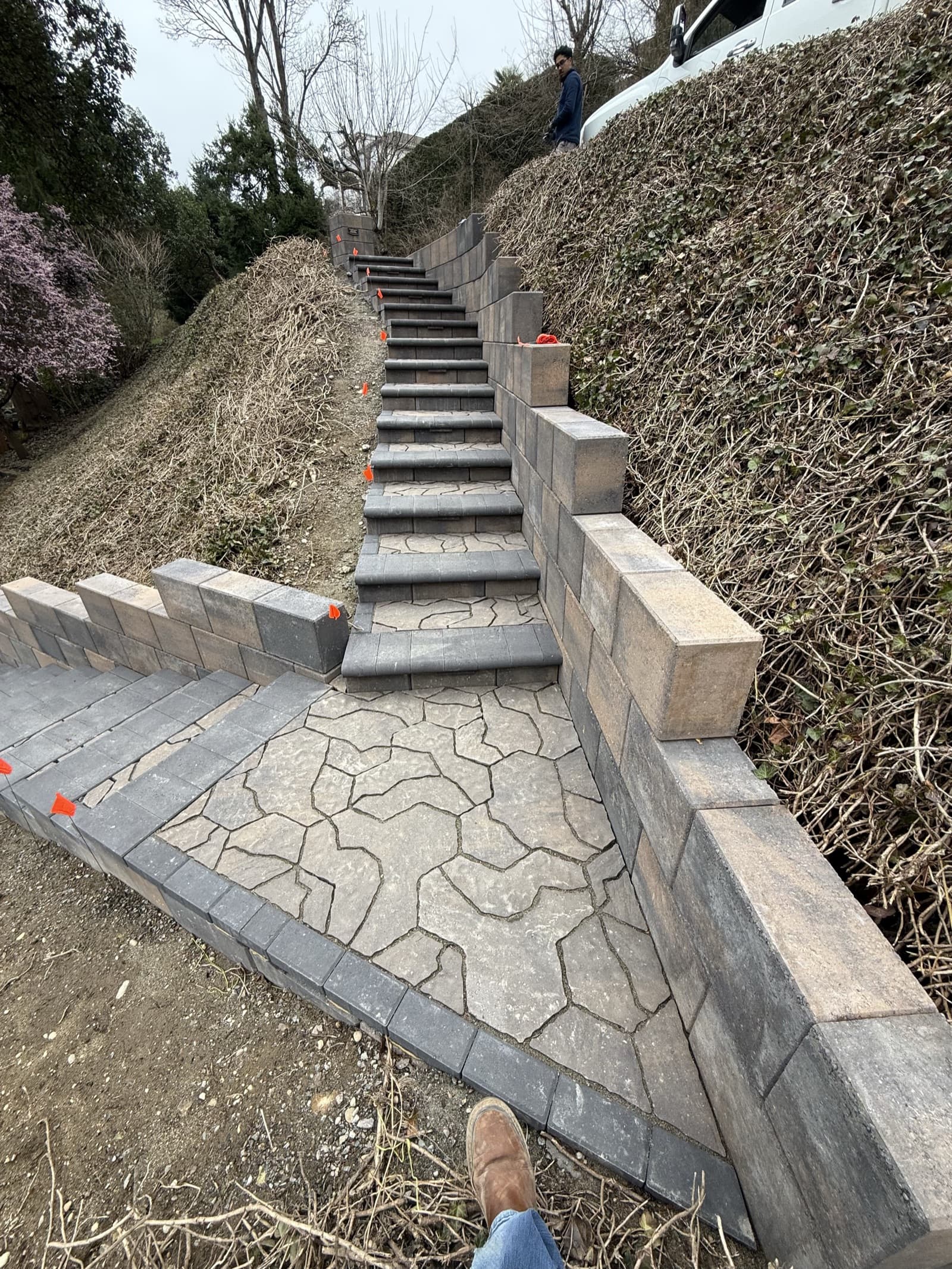
A paver base in Western Washington is a compacted layer of dense-graded crushed rock, built thicker for driveways than for patios, over native soil that is often wet for months. Depth depends on use and on how saturated the subgrade gets. This guide covers depth by use, base material, geotextile, compaction, and drainage, plus the questions to ask any installer about the part you will never see again.
Most paver base advice online is written for places with sandy soil and dry summers or deep frost. Our problem is different. Here, the ground under a patio is often soft and wet from fall to spring, and water is a bigger threat to a paver base than frost. That changes how a base should be built.
What is a paver base, and what does each layer do?
A standard paver surface has four parts from the bottom up:
- Subgrade. The native soil, excavated and compacted. Everything rests on it.
- Base. Crushed, dense-graded aggregate, placed and compacted in layers. This is the structure. It spreads load and gives water a path out.
- Bedding layer. A thin layer of screeded sand, commonly 1 to 1.5 inches, that the pavers are set into.
- Pavers and joints. The pavers, with sand in the joints and an edge restraint holding the field together at the perimeter.
When a paver surface sinks or ruts, the cause is almost always in the first two layers. The pavers and the sand on top are rarely the problem.
How deep should a paver base be?
Start with the minimums. The Concrete Masonry and Hardscapes Association (CMHA, which now publishes the former ICPI paver guidance) sets a minimum compacted base of 4 inches for sidewalks, patios, and pedestrian areas over well-drained soils, and 6 inches for residential driveways. It also says continually wet or weak soils require thicker bases. Those are floors, not targets.
A widely used industry overview from ConcreteNetwork gives these working ranges:
- Base thickness normally runs 6 to 12 inches.
- Bases for vehicle traffic are typically 10 to 12 inches.
- In extreme soil conditions, the base can be up to 18 inches.
- Many western jobs are built with 4 to 6 inches of base material.
That last line describes common practice in drier western climates. It is not a recommendation for a wet clay lot in Puyallup or a shaded north-facing yard in Gig Harbor. In this region, we treat the shallow end of those ranges as something the soil has to earn.
Here is how we think about depth by use:
| Use | What drives the base depth |
|---|---|
| Walkway | Foot traffic only. Depth driven mostly by soil and drainage. |
| Patio | Foot traffic, furniture, sometimes a fire feature or hot tub pad. Soil and drainage still govern. |
| Driveway | Wheel loads concentrated on small contact areas, plus turning and braking. Base depth and compaction go up. |
| Permeable pavers | The base is also a water reservoir, so depth is sized for storage, not only for load. |
These are categories, not a spec. The number for your project comes from your soil.
Why does saturated subgrade govern paver base design here?
In much of the Puget Lowland, the subgrade is not a uniform, free-draining material. A U.S. Geological Survey report on glacial till describes it as compact deposits that resemble concrete, often called "hardpan," and notes that north of Olympia till is the most common surface and near-surface material. Tacoma and most of Pierce County fall in that area, though glacial outwash gravels and local soils vary from lot to lot.
What that means on a job site:
- Water perches. Rain soaks into the looser soil near the surface and stops when it hits the dense till below. The layer your base sits on can stay saturated for weeks.
- Wet soil is weak soil. Silty and clay-rich soils lose strength when saturated. A subgrade that felt firm in August can be soft in January.
- Fines migrate. Under repeated load, wet fine soil pumps up into the gravel above it. The base slowly fills with mud, loses strength, and drains worse every year.
- Two parts of one yard can differ. Glacial deposits vary over short distances. One corner of a lot can drain well while another holds water.
That is why freeze-thaw, the headline topic in national paver guides, is usually not the main issue here. A paver base in the Tacoma area is more likely to fail from long periods of saturation than from frost.
When is geotextile fabric needed under a paver base?
The same industry overview says geotextile fabric should be used in moist or wet areas and where the soil is expansive, to separate native soil from the base. That describes a large share of the yards we work in.
A geotextile does one main job here: separation. It keeps fine soil out of the base so the gravel stays gravel. On soft subgrade it also helps spread load.
Two cautions:
- Weed fabric is not geotextile. Thin landscape fabric from a garden center is not designed to separate a structural base from wet soil under load.
- Fabric does not replace drainage. If water has no way out of the base, a geotextile keeps the base clean while it sits in water. You still need a slope and an outlet.
How should a paver base be compacted?
Compaction turns a pile of rock into a structure. The ConcreteNetwork overview calls for:
- Base placed in lifts no more than 4 inches thick, each compacted before the next.
- Pedestrian areas and residential driveways compacted to at least 95% standard Proctor density (ASTM D 698).
- Vehicle areas compacted to at least 95% modified Proctor density (ASTM D 1557).
- A roller or rammer on clay subgrade, where a plate compactor alone may not be enough.
CMHA's current construction tech note sets a higher bar, at least 98% of standard Proctor density for pedestrian areas and residential driveways, with 4 to 6 inch lifts for plate compactors in the common size range.
The ConcreteNetwork overview also says something that matters a lot here: weak or saturated soils may not reach the minimum density at all and may need stabilization or drainage. You cannot compact mud into a good subgrade. If the soil is pumping under the compactor, the fix is to remove it, dry it, stabilize it, or bridge it with more base and fabric. More passes with the plate will not help.
What does good drainage under a paver base look like?
A base built for this climate gives water three ways out:
- Surface slope. The finished paver surface slopes away from the house so most rain runs off before it soaks in.
- Subgrade slope. The compacted soil under the base is shaped to the same fall, so water that does get in can move toward an edge instead of pooling in a low spot.
- An outlet where needed. On flat lots, heavy soil, or patios that collect roof water, a perforated drain or a gravel outlet carries water out of the base to a place it can go.
Downspouts deserve their own line. A downspout that discharges onto a patio puts a roof's worth of water into one corner of the base every storm. We plan where that water goes before we dig.
How can you tell if a quote includes a real base?
The base is buried. You will never see it again once the pavers go down, which is why it is the easiest place to cut cost. Ask any installer:
- How deep will you excavate, and how much compacted base will be in place?
- What base material will you use?
- Will you compact in lifts, and how thick?
- Will you use a geotextile, and which kind?
- How will water leave the base?
- What will you do if you hit soft or wet soil during excavation?
If the answer to the last one is "we'll see," ask what that does to the price and schedule. Soft spots are common here, and a good contractor has a plan for them before the excavator arrives.
Is a deeper base always better?
No. More base costs more in excavation, haul-off, material, and labor, and on stable, well-drained ground it may add little. The goal is the right base for the soil and the load, built and compacted correctly. A thick base that is poorly compacted or that traps water performs worse than a thinner one that is built right.
That is the case for testing before designing. At ND Brick Pavers, we pull a soil sample at your property before we design or quote. The result tells us how much base you need, whether geotextile is needed, and whether drainage has to be part of the scope. The soil test is free, and it comes with no obligation.
Sources
- CMHA Tech Note PAV-TEC-002-22: Construction of Interlocking Concrete Pavements (PDF)
- ConcreteNetwork: Concrete paver installation overview
- U.S. Geological Survey Open-File Report 81-517: Composition of till from the Clear Lake quadrangle, Washington (PDF)
Frequently Asked Questions
How deep should a paver base be for a patio?
The paver industry's construction guidance sets a minimum of 4 inches of compacted base for patios and walkways on well-drained soil, and a national installation overview puts typical base thickness at 6 to 12 inches. Those are starting points for good, drained soil. On wet or clay-rich ground, a patio may need more base, a geotextile separator, or drainage. The right depth comes from the soil at your site, not from a fixed number.
How deep should a paver base be for a driveway?
Deeper than a patio. Industry construction guidance sets a 6-inch minimum for residential driveways on well-drained soil, and a national installation overview gives 10 to 12 inches as typical for vehicle traffic and up to 18 inches in extreme soil conditions. A driveway also needs thicker pavers and tighter compaction. On saturated subgrade, base depth and drainage matter more than the paver you choose.
What gravel is used for a paver base?
Standard pavers sit on a dense-graded crushed rock base: angular stone with a range of sizes, including fines, that compacts into a tight layer. Rounded rock such as pea gravel does not lock together and should not be used as base. Permeable pavers are the exception: they use open-graded clean stone so water can pass through and be stored.
Do I need landscape fabric or geotextile under pavers?
In moist, wet, or expansive soil, a geotextile separator between native soil and the base is recommended, because it stops fine soil from pumping up into the gravel. In much of Pierce and Thurston County, where silty and clay-rich soils stay wet for months, we use it often. Cheap weed-barrier fabric is not the same product as a construction geotextile.
Can you put pavers directly on dirt or sand?
Not if you want them to stay flat. Native soil compresses unevenly and softens when wet, and bedding sand alone washes and migrates. Pavers on dirt or sand will rut and dip, especially in our wet season. A compacted aggregate base is what carries the load.
How thick should the sand layer under pavers be?
The bedding layer is thin, commonly 1 to 1.5 inches of screeded sand over the compacted base. It is not a leveling layer for a bad base. If an installer is using several inches of sand to fill low spots, the base below was not built to grade, and those low spots will show up again.