
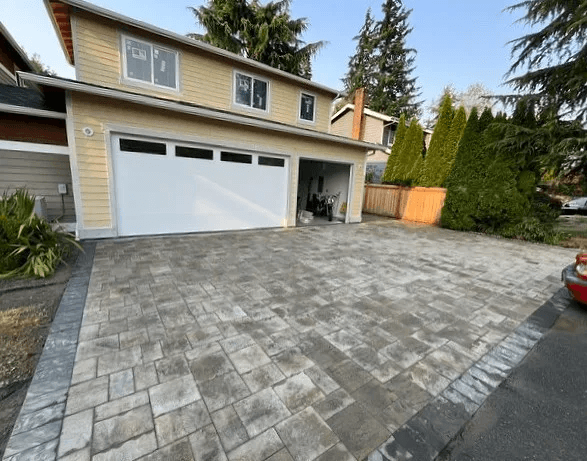
Asphalt costs less up front and goes in fast, but it ages from sun and water, needs sealcoating, and repairs show as patches. A paver driveway costs more to build, can be repaired section by section without a visible scar, and can be built permeable. On western Washington's wet soils, both depend on the base. ND Brick Pavers compares the two on a free on-site quote.
We already have a separate comparison of pavers and poured concrete. This one is about asphalt, which behaves very differently from concrete and is a common choice for long driveways on larger rural lots. I install pavers for a living, so I will give asphalt its wins first.
Where does asphalt actually win?
Upfront cost. For the same footprint, asphalt usually costs less to install than pavers. On a long driveway that runs a few hundred feet to a house set back from the road, that difference is large, and asphalt is often the sensible answer.
Speed. An asphalt driveway is paved in a short window once the base is ready. Pavers are laid by hand and take longer.
A continuous surface. No joints means nothing for weeds or moss to root in, and snow plows or shovels glide over it.
Simple, functional driveways. For a shop approach, a rural access drive, or a parking pad behind a house, the look of asphalt does not matter and its lower cost does.
If that describes your driveway, asphalt is a defensible choice and I will tell you so.
Where do pavers win?
Repairs that disappear. When a section settles, a tree root lifts it, or a utility line has to be dug up, we lift the pavers, fix what is underneath, and reset the same units. An asphalt patch is visible from the street on day one and usually stays visible.
No sealcoating cycle. Asphalt ages as sun and air oxidize the binder and water works into cracks. Sealcoating and crack filling slow that down, and they need to be repeated. Pavers do not need a coating to stay intact. Sealing is optional and mostly about appearance and stain resistance.
Curb appeal. Color, pattern, borders, and banding can be matched to the house and tied to the walkway and patio. Asphalt reads as a utility surface.
Edges that hold. Asphalt edges with no support crumble and break off, especially where tires run near the edge. A paver driveway is built with an edge restraint that keeps the field locked in place.
A permeable option that can help a project with stormwater requirements, covered below.
One of our Google reviewers, ttvolvo, replaced a 25-year-old driveway that had sunk and cracked with a paver driveway from us. The build took about two weeks with cleanup each day, and our team helped adjust options to fit the budget. The review does not say what the old driveway was made of, but the pattern is common: a driveway that sinks and cracks has a base problem, and replacement is the time to rebuild the base.
How do asphalt and pavers handle western Washington rain and soil?
Asphalt and pavers are both flexible pavements. Neither is a rigid slab like concrete. They both rely on the aggregate base underneath to carry the load, and they both fail the same way when that base gets wet and soft.
Around Tacoma, that is the real issue. NOAA's 1991 to 2020 normals for Sea-Tac show about 39 inches of rain a year, with roughly three quarters falling from October through March. Much of the region sits on dense glacial till that drains slowly, so water that gets into a driveway base can sit there for months.
The difference is how each surface handles that water:
- Asphalt sheds water from its surface, but once cracks open, water goes straight into the base. Wet base plus traffic is how potholes and alligator cracking start, and both spread.
- Pavers let a small amount of water through the joints by design, so the base has to be built to drain. When it is, settlement is slow and local. When a spot does settle, it is repaired in that spot.
Either way, the driveway needs a base sized for vehicle loads and your soil, a crown or slope that sends water off the surface, and somewhere for that water to go. A free soil test tells us what your subgrade is before we design either one.
What maintenance does each need?
Asphalt:
- Fill cracks as they open, before water gets into the base.
- Sealcoat on a regular cycle to slow oxidation.
- Keep edges supported and water from pooling at the low side.
- Know the product rules. Under RCW 70A.440.020, coal tar pavement products labeled as containing coal tar cannot be sold in Washington after January 1, 2012, and coal tar sealant cannot be applied to a driveway or parking area after July 1, 2013.
Pavers:
- Top up joint sand when joints drop, usually in high-traffic lanes.
- Clean off oil and leaf stains, and blow off needles.
- Control moss in shaded areas, which is more common on driveways under trees.
- Seal if you want richer color or easier cleanup. It is optional.
Which driveway is easier to repair?
Pavers, by a clear margin. A settled area, a root lift, or a utility trench is a lift-and-relay of the affected section, using the same pavers. Done properly, you cannot find the repair a year later.
Asphalt repairs work, but they are patches. A trench across an asphalt driveway leaves a visible band. Settled areas are overlaid or cut out and replaced, and the new material never quite matches the old.
Can either driveway be permeable?
Yes, and this matters if your project is large enough to trigger stormwater requirements.
The City of Tacoma publishes a typical permeable driveway detail (Figure 017, September 2025). It shows a porous asphalt section with a 4-inch minimum porous asphalt surface and a pervious concrete section, both over permeable ballast and a 6-inch minimum treatment layer, and it notes that permeable pavers may be allowed with an appropriate reservoir layer per the manufacturer and the stormwater manual. The detail applies to driveways that are flat or slope away from the house.
Permeable systems of either type need soil that can accept water, a reservoir sized by calculation, and maintenance to keep the surface from clogging. The Washington Stormwater Center recommends deep cleaning permeable pavements at least once or twice a year. For a homeowner, permeable pavers are often easier to live with than porous asphalt, because a clogged or damaged area can be lifted and cleaned or replaced.
Paver driveway vs asphalt: side by side
| Asphalt | Pavers | |
|---|---|---|
| Upfront cost | Wins. Usually lower for the same area. | Higher. Driven by base depth, pattern, and site work. |
| Install time | Wins. Short paving window. | Longer, hand-laid. |
| Surface joints | Wins. None. | Joints need sand and occasional moss control. |
| Routine maintenance | Crack filling and sealcoating cycles. | Wins. Joint sand and cleaning; sealing optional. |
| Repairs | Visible patches. | Wins. Lift and relay the same units. |
| Edges | Crumble without support. | Wins. Locked by edge restraint. |
| Curb appeal | Utility look. | Wins. Colors, patterns, borders. |
| Permeable option | Porous asphalt. | Permeable pavers, easier to service. |
| Wet-soil performance | Depends on the base. | Depends on the base. |
What drives the cost of each?
We do not publish prices, because they depend on the site. The factors that move both numbers are the same:
- Driveway size and shape.
- Removal and disposal of the existing surface.
- Soil type and base depth needed for vehicle loads.
- Drainage: slope, trench drains, downspout routing.
- Slope and access for equipment.
- Curb cut or apron work, and permits.
- For pavers: paver style, pattern, and borders.
A free on-site quote itemizes these so you can compare apples to apples.
Do you need a permit to replace a driveway in Tacoma?
Tacoma exempts driveways from a building permit, with the note that a separate site development permit may still be required. That permit is triggered by 2,000 square feet or more of new or replaced hard surface, more than 50 cubic yards of grading, or 7,000 square feet of disturbance.
Any work on the curb, sidewalk, or driveway approach in the street needs a right-of-way permit. Tacoma handles smaller apron work with a Right-of-Way Construction permit that needs a site plan and a traffic control plan. Other cities and the county have their own rules, and we confirm them for your address before we quote.
Which should you choose?
Choose asphalt if:
- The driveway is long and mostly functional.
- Lowest upfront cost is the priority.
- You are comfortable with a crack filling and sealcoating routine.
Choose pavers if:
- The driveway is part of the home's front view.
- You want repairs to be invisible.
- You plan to stay for years and want to avoid a coating cycle.
- You may need a permeable option for stormwater.
Some homeowners split it: asphalt for the long run from the road, pavers for the apron and parking court near the house.
Questions to ask any driveway contractor
- What is my subgrade, and how did you check?
- How deep is the base, and why that depth for vehicles on my soil?
- Where does water go off the surface and out of the base?
- What happens at the edges?
- Does the job touch the street apron, and who handles the permit?
- What maintenance should I expect in the first few years?
How ND Brick Pavers builds driveways
We start with a free soil test, design the base for vehicle loads and your soil, and use in-house crews for the build. If asphalt is the better answer for your driveway, we will say so. Our office is in Yelm, and our crews work across Tacoma and Pierce County.
Sources
- Washington State Legislature: RCW 70A.440.020, coal tar pavement products
- City of Tacoma: Permeable Driveway typical detail, Figure 017 (September 2025)
- City of Tacoma: What Requires a Permit
- City of Tacoma: Types of Permits
- Washington Stormwater Center / WSU Extension: Permeable Pavements homeowner guide
- NOAA NCEI: 1991-2020 monthly normals, Seattle-Tacoma International Airport
- USGS Open-File Report 00-228: Geotechnical Properties for Landslide-Prone Seattle Area Glacial Deposits
Frequently Asked Questions
Is a paver driveway better than asphalt?
It depends on the driveway. Asphalt is the better buy for long, plain driveways where the lowest upfront cost matters most. Pavers are the better buy for driveways that are part of the home's curb appeal, where repairs should be invisible, and where you want to avoid sealcoating. On wet Pierce County soil, both depend on a well-built, well-drained base.
Do paver driveways need more maintenance than asphalt?
Different maintenance, not necessarily more. Asphalt needs crack filling and periodic sealcoating to slow aging from sun and water. Pavers need joint sand topped up, occasional cleaning, and moss control in shady spots. Sealing pavers is optional. Neither surface is maintenance-free in a climate this wet.
Can you put pavers over an existing asphalt driveway?
It is rarely a good idea. Asphalt flexes, cracks, and holds water on its surface, so pavers set on top inherit every problem in the old driveway and have nowhere to drain. The reliable approach is to remove the asphalt, check the subgrade, and build a proper aggregate base.
Is asphalt sealcoat with coal tar allowed in Washington?
No. Under RCW 70A.440.020, coal tar pavement products labeled as containing coal tar cannot be sold in Washington after January 1, 2012, and coal tar sealant cannot be applied to a driveway or parking area after July 1, 2013. Ask any sealcoating contractor what product they use.
Can an asphalt or paver driveway be permeable?
Both have permeable versions. The City of Tacoma's permeable driveway detail shows porous asphalt and pervious concrete sections and notes that permeable pavers may be allowed. A permeable driveway needs a reservoir base, a treatment layer, and soil that can take the water, so it starts with a soil test.
Which driveway adds more to curb appeal?
Pavers, in most cases, because color, pattern, and borders can be matched to the house. Asphalt reads as a utility surface. Whether that difference matters depends on the house, the neighborhood, and how long you plan to stay.
Do I need a permit to replace my driveway in Tacoma?
Tacoma exempts driveways from a building permit, but a site development permit is required for 2,000 square feet or more of new or replaced hard surface, and any work on the curb, sidewalk, or driveway approach in the street needs a right-of-way permit. Most single driveway replacements only need the right-of-way piece, if they touch the apron.