
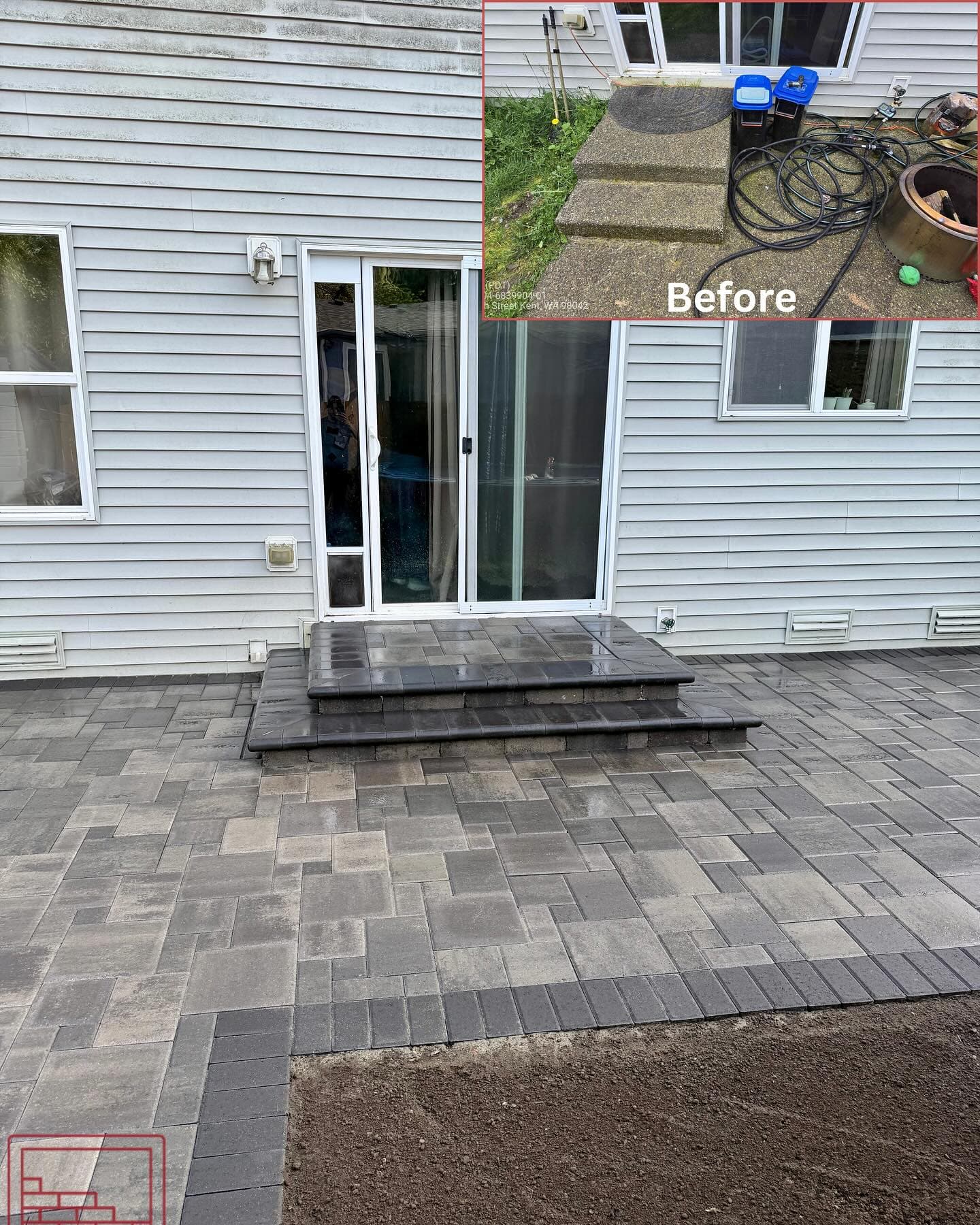
A paver patio price in the South Sound depends on far more than the surface area. Material, soil, base depth, demolition, drainage, pattern and access all affect the final quote. Driveways generally cost more than patios because vehicle loads require a stronger base.
This page shows you what belongs in an honest quote, including the real work buried under the pavers that you will never see again after the last stone goes down.
What drives the cost to install pavers
- Material. Standard concrete pavers generally cost less than premium concrete, porcelain or natural stone.
- Layout. Simple rectangles require fewer cuts than curves, borders and complex patterns.
- Site conditions. Slope, soil, drainage and demolition change the excavation and base work.
- Access. Machine access reduces the labor needed to move soil and base material.
- Use. Driveways need more excavation, base material and compaction than pedestrian patios.
Small jobs price higher per square foot than big ones. Getting a crew, an excavator, a compactor and a dump trailer to your address costs about the same whether the patio is 150 square feet or 600. That mobilization gets divided across the area. So if you want a number for your specific yard fast, the paver cost calculator will get you in the right neighborhood in about a minute.
Paver patio cost: where the money actually goes
Homeowners tend to assume the paver is the expensive part. It often is not. Excavation, rock, labor and removing the old surface can drive more of the total than the visible material.
Here is the full line-item list, in the order the money leaves the job:
Demolition and haul-off. If there is a cracked concrete slab where the patio is going, it has to be broken out and trucked away. Concrete is heavy, dump fees are by the ton, and a slab with rebar in it is slower to break than one without. Demolition can turn an otherwise simple project into a much larger one.
Excavation. You are digging out the depth of the base plus the sand plus the paver. For a patio that means going down roughly 9 to 13 inches. For a driveway, 13 to 20. That dirt does not evaporate; it goes in a truck and gets paid for by the load.
The base. Compacted crushed rock. This is the single biggest driver of cost and the single biggest driver of whether your patio is still flat in ten years. More on this below, because in the Pacific Northwest it is the whole ballgame.
Bedding sand and the pavers. A thin, screeded setting layer, then the stone itself. Standard concrete pavers are the cheapest. Tumbled and textured lines cost more. Porcelain and natural stone can add material and installation costs.
Pattern and cutting. A running bond with straight edges wastes very little material and cuts fast. A 45-degree herringbone against a curved border generates cuts on every perimeter stone, a pile of unusable offcuts, and hours on the saw. That is real labor, and honest bidders price it in.
Edge restraint. The plastic or concrete edge that keeps the perimeter pavers from creeping outward. It is a small line item, and skipping it is a well-known way to make a patio unravel from the outside in.
Drainage. Grading, a French drain, a channel drain, tying into a downspout. Optional in Phoenix. Frequently not optional here.
Access. This one blindsides people. If the crew can drive a machine to the work area, excavation is a few hours. If the only way in is a 36-inch side gate and every yard of dirt out and every yard of rock in has to move by wheelbarrow, the same job can take days longer. Same patio and same pavers, but a materially different quote.
Paver installation cost per square foot: why the base decides it
If you take one thing off this page, take this. In Western Washington, the base is the cost, and the base is the difference between a patio that lasts and a patio that heaves.
The ground here is glacial till, Vashon drift and Puget lowland clay. It does not drain like the soil the national paver manuals were written for. We get roughly 39 inches of rain a year, most of it concentrated in a wet stretch where the subsoil stays saturated for about five months straight. A saturated subgrade is a soft subgrade, and a soft subgrade under a thin base is a patio that moves.
A dry-climate install can get away with 4 to 6 inches of compacted rock under a patio. Here, a patio base is typically 6 to 10 inches, and a driveway base is often 10 to 14. On heavy clay it can go deeper, and it may need a geotextile fabric between the subgrade and the rock so the clay does not pump up into your base over a few wet winters and turn it into mud.
Every one of those extra inches is rock you buy, dirt you dig out and haul away, and time on the compactor. That is why the same patio can cost materially more on saturated clay than on sandy, well-draining ground nearby.
The cheap quote is usually a thin base
When one bid comes in far below the others, the base is where the difference often went. It is the one line item nobody can inspect once the job is done. You will never dig up your own patio to count inches of rock.
You will find out in year three, when one corner is an inch lower than the rest and the joints have opened and water pools where it did not used to.
Here is how to check before you sign, not after:
- Ask for the base depth in inches, in writing. "Proper base" is not an answer. A number is an answer. If a bidder will not put a number on the estimate, that tells you what you needed to know.
- Ask what they are compacting. Crushed rock with fines that locks together under a plate compactor is a base. Loose gravel or a pile of sand is not.
- Ask if they compact in lifts. You cannot dump 10 inches of rock and compact it all at once. It gets built up and compacted in layers, typically 3 to 4 inches at a time. If the answer is vague, the layers are not happening.
- Ask what they did to find out what your soil is. If nobody dug a test hole in your yard, nobody knows how much base your yard needs, and the number on that estimate was a guess dressed up as a bid.
- Ask where the water goes. If the answer is "it'll drain," it will not.
Any bidder who can answer those five questions crisply is a bidder worth taking seriously, including the ones that are not us.
How we arrive at a number
I will not publish a price for your yard on a blog post, because I do not know what is under it yet. What I can tell you is exactly how we get there, and why our estimate looks different from the one-page number most people get handed.
We dig a soil test first, and we do not charge for it. Clay content, drainage, compaction. That test is what sets the base depth, and the base depth is what sets most of the price. Quoting before the soil test would mean guessing at the largest line item on the job, and that is how a bid becomes a change order later.
You get a 3D rendering before you commit, free. We model the patio in ArcSite so you can see the layout, the pattern, the border and the material before a shovel moves. It is cheaper to change your mind in the software than in the yard.
The estimate is itemized line by line. Excavation, haul-off, base rock, fabric, bedding, pavers, cuts, edge restraint, drainage, cleanup. Not one lump-sum figure with everything hidden inside it. You can see what each part costs and you can see what happens if you change the scope. The number you sign is the number you pay.
The crew that shows up is our crew. We do not sub out the install. The people who dug your soil test are the people who build your base, which is the only way I know to be certain the base that got priced is the base that got built.
Ask us for the written workmanship warranty terms before you sign. Standing behind the base is the reason I am blunt about base depth. We are the ones who come back if it settles.
What to do next
If you want a fast ballpark before you talk to anyone, run your square footage through the paver cost calculator. It will not be exact, and it is not meant to be, but it can help you understand how scope choices affect the estimate.
If you already know roughly what you want built, the details for each are on the paver installation and paver patio pages.
And when you want a real number for your actual yard, get a free estimate. We will dig the soil test, model the design, and hand you an itemized sheet you can hold up against every other bid you have.
— Jose Nieto, ND Brick Pavers
Frequently Asked Questions
How much does it cost to install pavers per square foot?
There is no reliable square-foot price without seeing the site. Material, base depth, demolition, drainage, pattern complexity and crew access all change the total. Basic concrete pavers on flat, machine-accessible ground generally cost less than natural stone or porcelain on a site that needs demolition, drainage work or wheelbarrow access. The paver itself is often a smaller cost driver than the work under it.
What does a paver patio cost in total?
The total depends on the patio size, material, access and how much base the soil demands. Small patios can cost more per square foot than large ones because mobilization, excavation setup and haul-off are close to fixed costs spread over less area.
Why is one paver quote much cheaper than another?
Almost always the base. The base is buried, so it is the one line item a homeowner cannot inspect after the fact, and it is the easiest place to save money without the customer noticing until year three. Ask both bidders, in writing, how many inches of compacted crushed rock they are installing and whether they are compacting in lifts. If one says 4 inches and the other says 8 to 12, you are not comparing the same project.
Is it cheaper to pour concrete than to install pavers?
Poured concrete is usually cheaper up front, often meaningfully so. The tradeoff is what happens later. Concrete in this climate cracks as the ground below it moves, and a crack is a repair or a replacement. A paver surface is made of individual units, so ground movement shows up as a settled section you can lift, re-base and reset. Cost per year of service is a different question than cost on day one.
Does the size of the patio change the price per square foot?
Yes, and it surprises people. A 150-square-foot patio can price out higher per square foot than a 600-square-foot one. Bringing in a crew, an excavator, a plate compactor and a dump trailer costs roughly the same either way, and that fixed cost gets divided across the area. If you are on the fence about size, the marginal square foot is usually cheaper than the first one.
Do you charge for the estimate or the soil test?
No. The soil test and the 3D rendering are both free and both happen before we give you a number, because we cannot honestly price the base until we know what is under your yard. The estimate that follows is itemized line by line, so you can see what the base, the excavation, the haul-off and the material each cost. The number you sign is the number you pay.