
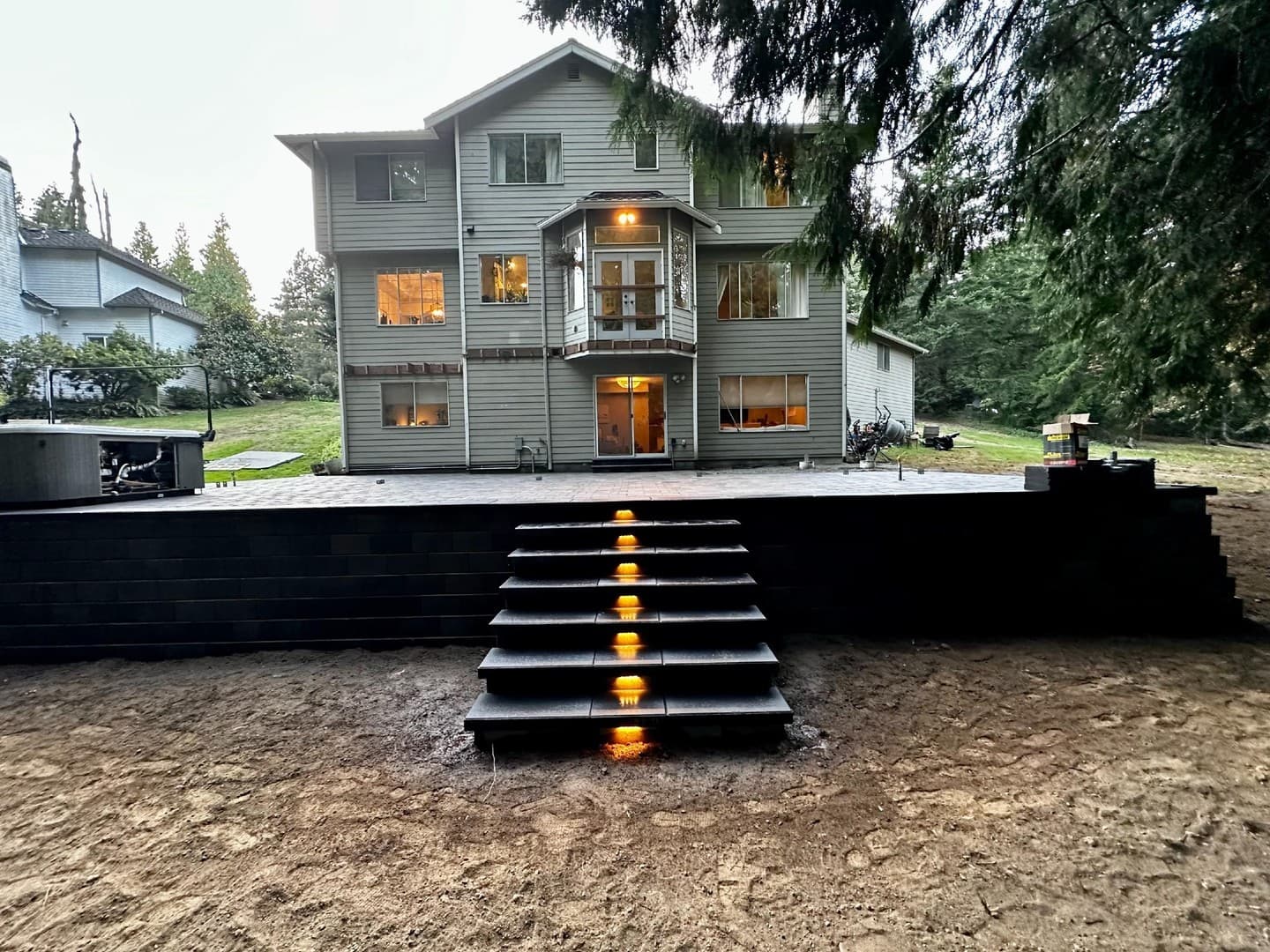
The best paver patio ideas for the Pacific Northwest start with water and shade, then style. Pitch the patio toward a bed or drain, cover part of it for the wet months, choose textured, blended pavers that hide moss and needles, and use seat walls and terraces on slopes. ND Brick Pavers designs patios around Tacoma soil and rain, with a free 3D design.
Most patio idea galleries are shot in places where it rarely rains. The photos are fine. The trouble is that a patio that looks right in Phoenix can be a slippery, green, puddled mess by its second November here. The ideas below are the ones that hold up in western Washington, with the reasoning for each, so you can adapt them to your own yard.
Why do patio ideas need to change for the Pacific Northwest?
Three conditions drive almost every design choice here:
- Rain, concentrated in winter. NOAA's 1991 to 2020 normals for Sea-Tac show about 39 inches a year, and roughly three quarters falls from October through March. November averages over 6 inches.
- Shade and slow drying. Tall firs, cedars, and big-leaf maples keep many yards shaded and damp, which favors moss and algae.
- Ground that holds water. Much of the region sits on dense glacial till that drains slowly, so a patio that does not shed water will sit on wet ground for months.
None of that rules out a beautiful patio. It just means the good ideas are the ones that plan for it.
Which paver patio layouts work best for wet yards?
Split the patio into a covered zone and an open zone. Put the dining table or the grill under a roof or a solid pergola near the house, and keep the lounge or fire area open to the sky. You get a patio you can use in a March drizzle and one you can enjoy in August sun.
Build drainage into the shape. A patio needs a slight pitch away from the house. Instead of dumping that water on the lawn edge, aim it at something: a gravel strip, a planting bed with plants that like wet feet, or a channel drain at a door.
Use a permeable section at the low spot. If one corner of the yard always puddles, a permeable paver band or landing there can take water into a stone reservoir below. This depends on soil, so it needs a test first.
Keep the patio below the house siding. The finished surface should sit well below siding and any weep openings, with the slope running away. Raising a patio to meet a door threshold without thinking about the siding is a common way to push water into a wall.
Separate the patio from the downspouts. Route roof water under the patio in a solid pipe, not across it. A downspout spilling onto pavers keeps that area wet and green.
Which paver colors and textures hold up to moss and rain?
Choose a texture that grips when wet. Tumbled, textured, or slightly rough-faced pavers stay safer underfoot in rain than smooth, slick faces. This matters most on steps and on shaded patios that stay damp.
Choose blends over solids. Mottled, multi-tone blends hide moss, fir needles, and dirt between cleanings. A solid light paver under trees will show every green streak. A solid black paver shows leaf stains and dust.
Match the house. Pull a color from the roof, trim, or stone on the house. Gray and charcoal blends suit most Northwest houses with dark roofs. Warmer tan and red blends suit brick and craftsman homes.
Use a border. A contrasting soldier course or banding around the edge gives a simple patio a finished look and helps the edge restraint do its job.
Plan joints for shade. In shaded yards, joint material and joint width affect how fast moss and weeds return. Tighter joints with a properly installed joint sand help. Polymeric sand needs dry conditions to install. One major manufacturer specifies a dry surface and no rain in the forecast for at least an hour on a drainage base, and up to 24 hours on a non-drainage base.
How can a fire pit or fire feature fit into a paver patio?
A fire area is one of the easiest ways to make a patio usable on cool evenings, and it works well with pavers.
- Sunken or level fire area: a round or square fire zone at the edge of the main patio, ringed by a seat wall, makes the fire a destination instead of an obstacle.
- Seat walls instead of extra chairs: a curved wall at seat height gives built-in seating that does not blow away or need storage in winter.
- Gas or wood: wood gives the smell and crackle. Gas gives instant on and off. The Puget Sound Clean Air Agency prohibits outdoor fires, including fire pits and chimineas, during a Stage 1 burn ban, and those bans tend to come in stagnant winter weather. That is a practical reason many homeowners here choose gas.
- Placement: keep any fire feature well away from the house, eaves, overhangs, and low branches. Check your fire pit manufacturer's clearances and your local fire rules.
How do you build a paver patio on a sloped yard?
Slopes are common around Tacoma, from the hills of the North End to the bluffs along the Sound. A slope can be the most interesting yard to design, as long as the walls and drainage are right.
- Terrace it. Two or three level patios stepping down the hill give more usable space than one patio fighting the grade. Each level can have a purpose: dining near the house, a fire area below, a lawn or turf at the bottom.
- Use seat walls as retaining walls. A short wall that holds back a step in grade can double as seating.
- Keep walls short where you can. In Tacoma, a retaining wall over 4 feet from the bottom of the footing, or one holding up a surcharge like a driveway or slope, needs a building permit.
- Design steps that feel right. Tacoma's porch and deck tip sheet lists a maximum stair rise of 7-3/4 inches and a minimum tread depth of 10 inches, with handrails on any set of four or more stairs. Those figures are written for porch and deck stairs, not as a rule for landscape steps, but they are a useful comfort check. Outdoors, lower risers and deeper treads usually feel better.
- Drain every wall. Each retaining wall needs drainage behind it. On a slope, water is moving downhill whether you plan for it or not.
What small paver patio ideas work on city lots?
Smaller lots in older Tacoma neighborhoods often have narrow side yards and small backyards. Ideas that make the most of tight space:
- A bistro patio by the back door sized for two chairs and a small table, with a border so it looks finished.
- A paver path that widens into a landing, so the walkway and patio read as one design.
- Pavers plus turf. A small paver patio with artificial turf around it gives a dog or kids a soft area without a muddy lawn.
- A side yard turned into a usable path with pavers and a gate, instead of a strip of mud and moss.
- Lighting in steps and walls so a small space is usable after the early sunsets of fall and winter.
How do you connect a patio to the rest of the yard?
- Walkways from the driveway, side gate, or garden in the same paver or a coordinating one.
- Stepping pads set into turf or gravel for a softer transition.
- Banding that repeats from patio to walkway to driveway, tying the property together.
- Low walls or planting beds to define rooms without fences.
Which patio ideas look good online but fail here?
- Dead flat patios. Water sits, moss grows, and the base stays wet.
- Wood seat walls and planters on the ground. They stay damp and rot.
- Smooth, polished pavers in shade. Slippery when wet.
- Light, solid colors under trees. They stain green and brown.
- A patio built up against the siding. Water ends up in the wall.
- A thin base on clay or till. It looks fine for a year, then settles in the wet season.
How should you choose the right patio idea for your yard?
Use this short list before you look at pavers:
- Where does water go now in a heavy rain, and where should it go?
- How much of the yard is in shade most of the year?
- What will you do on the patio: eat, lounge, cook, gather around a fire?
- Do you want to use it in the wet months? If so, what will be covered?
- Is the yard sloped, and will any wall need a permit?
- What does the house look like, and which colors will match it?
How ND Brick Pavers designs a patio
We start with a free soil test and a site visit, then build a free 3D design so you can see the layout, colors, and levels before anything is dug. Our in-house crews build the base, drainage, walls, and patio. Our office is in Yelm, and our crews work across Tacoma and Pierce County.
Sources
- NOAA NCEI: 1991-2020 monthly normals, Seattle-Tacoma International Airport
- USGS Open-File Report 00-228: Geotechnical Properties for Landslide-Prone Seattle Area Glacial Deposits
- City of Tacoma: What Requires a Permit
- City of Tacoma: Residential Porches and Decks tip sheet
- Puget Sound Clean Air Agency: Stage 1 burn ban notice, Pierce County (November 2023)
- Alliance Gator: 10-step polymeric sand installation guide
Frequently Asked Questions
What is the best paver patio design for a rainy climate?
One that moves water on purpose. A patio pitched away from the house toward a planting bed, a drain, or a permeable section stays usable through the wet season. Add a covered area for the months when it rains most days, and choose a textured paver that stays grippy when wet.
What color pavers hide moss and needles best?
Blended, mottled colors in mid-tones hide moss, fir needles, and dirt far better than solid light or solid dark pavers. Light pavers show every green streak in shade, and very dark pavers show leaf stains and dust. A blend that matches the house trim or roof usually looks right for years.
Can I put a fire pit on a paver patio?
Yes. Concrete pavers make a good surface around a fire pit, and the pit itself is usually built with block and a steel or refractory liner. Keep it well away from the house, overhanging branches, and any roof. Around Tacoma, wood fires are prohibited during Stage 1 burn bans, so many homeowners choose gas.
How do you build a paver patio on a slope?
Usually with terraces: two or three level areas separated by short retaining walls or seat walls, connected by steps. A wall over 4 feet from the bottom of the footing, or one holding up a driveway or slope, needs a permit in Tacoma. Terracing keeps each wall shorter and gives you more usable space.
What patio shape gives the most usable space?
Plan the shape around what you will put on it. A dining table for six plus chairs pulled out needs more room than people expect, and a lounge area needs space to walk around the furniture. Lay the furniture out on the lawn with tape or a hose before you settle on a size, then curve or angle the edges to fit the yard.
Is a paver patio better than a deck in the Pacific Northwest?
For ground-level outdoor space, pavers usually last longer with less upkeep, because there is no wood to rot, stain, or replace. Decks make sense when the yard drops away steeply from the door. Many homes combine them, with a small deck or landing at the door stepping down to a paver patio.