
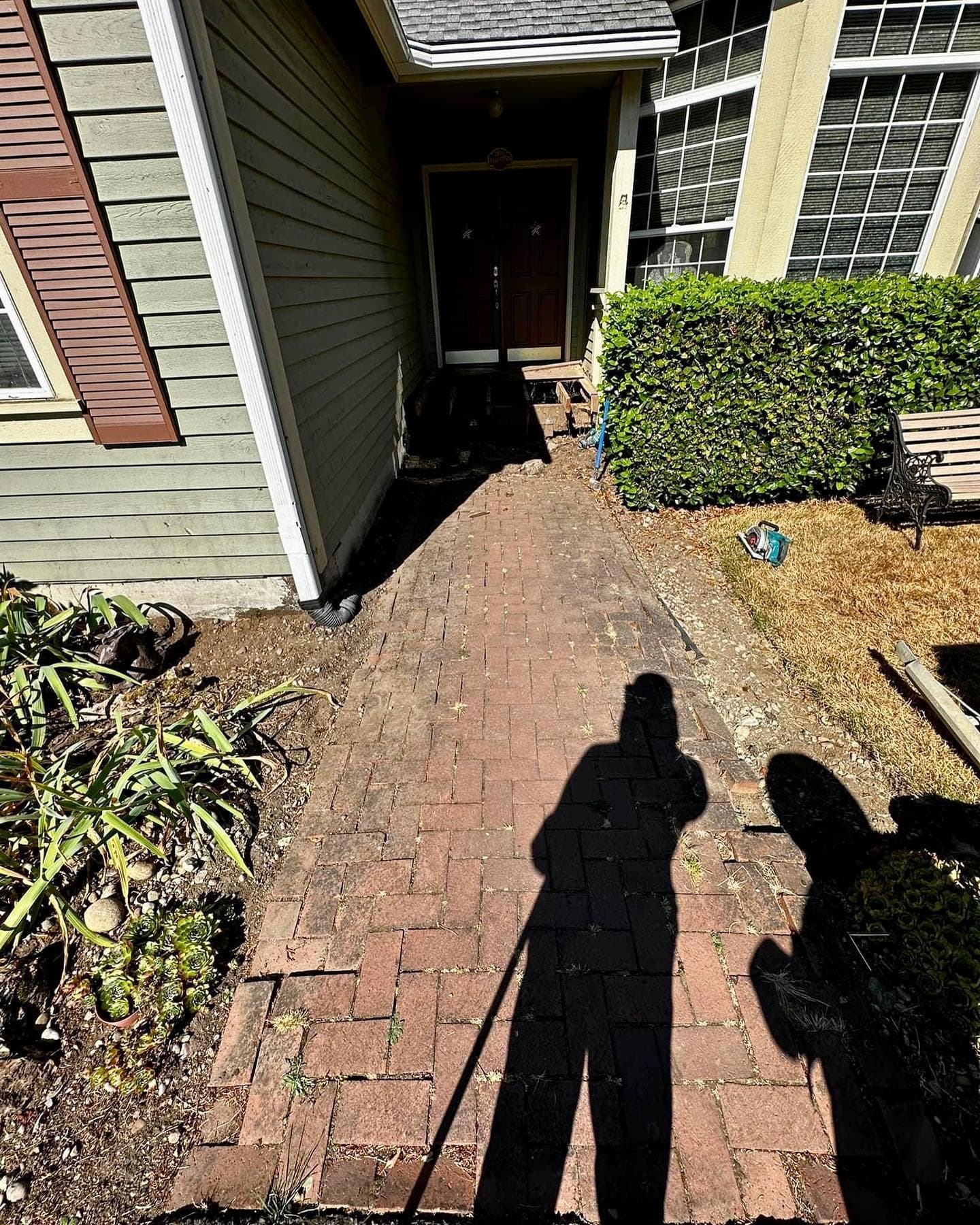
I install pavers for a living, so start with the part I have no incentive to tell you: on plenty of jobs, poured concrete is the right call. If a comparison article never gives the other side a real win, it is a sales page wearing a lab coat. This one gives concrete its wins first, and then makes the case for pavers on ground I actually understand — Pierce County ground.
Where poured concrete actually wins
These are not throwaway concessions. They are the reasons homeowners choose concrete and are happy about it.
It costs less up front. This is concrete's biggest and most honest advantage. A paver driveway needs base preparation and installation work that differs from poured concrete. Request a free quote for the same footprint and compare the full scope before deciding which option fits your budget.
It gives you one uninterrupted surface. A pour has no joints. On a long modern approach, a clean sweep of a courtyard, or a minimalist patio where the point is the unbroken plane, concrete does something pavers structurally cannot: it reads as a single object. If that is the look you want, pavers are a compromise, not an upgrade.
Some modern concrete finishes are genuinely good. Exposed aggregate, saw-cut score lines, integral color, board-formed edges — done well by someone who knows the material, these are handsome and architecturally correct on the right house. The mental image of a cracked gray driveway is not the ceiling of what concrete can look like.
It is faster and simpler on a simple site. Flat ground, good drainage, straightforward shape: a pour is fewer days of crew on your property.
It has no joints to maintain. No polymeric sand to refresh, no joint lines for weeds to find. That is a real maintenance advantage, and I am not going to pretend otherwise.
So if your ground is stable, well-drained, and your budget is tight, concrete is a defensible choice and I will tell you so at your kitchen table.
Now here is the problem with that sentence in this region: "if your ground is stable" is doing an enormous amount of work.
The case for pavers is physics, not taste
Every honest version of this argument comes down to one property of the material, and it has nothing to do with color, pattern, or style.
A concrete slab is one rigid piece. A paver field is thousands of independent pieces.
That sounds like a design detail. In South Puget Sound it is the entire outcome.
Our ground does not hold still. Expansive clay swells when it takes on water and shrinks when it dries out. We get roughly 39 inches of rain a year, and the subgrade in a lot of Pierce County yards stays saturated for something like five months of it. Under that sits glacial till, Vashon drift, and Puget lowland clay — a subsurface that was compacted and scraped by ice, not laid down flat and even for our convenience. Two corners of the same yard can behave like two different job sites.
Give that ground a rigid slab and it will eventually find the slab's limit. Concrete has very little tensile strength; it resists being crushed far better than it resists being bent or pulled apart. When the soil under one section swells and the soil under another settles, the slab is asked to span the difference, and it does the only thing it can do — it fractures. That is not a workmanship failure. That is concrete behaving exactly as concrete behaves.
And here is the part that matters most to your wallet: a cracked slab is a replacement, not a repair. You can patch it, fill it, grind it, resurface it. What you cannot do is make it go away. The patch is visible on day one and more visible every year after, and the crack is a permanent record of the day the ground moved.
A paver field answers the same movement completely differently. The pavers sit on a compacted aggregate base with sand-filled joints between the units — a flexible system by design. When the ground shifts, the field flexes with it. The movement distributes across thousands of joints instead of concentrating into one fracture line. Nothing has to span anything.
And when something does go wrong — a settled low spot, a base washout, a utility line that has to come up — we lift the affected pavers, fix what is underneath, and re-lay the same pavers. Not new ones. The same ones, with the same weathering as the rest of the field, back in the same pattern. Done properly, a paver repair is invisible.
That is the whole argument. It is strongest exactly where I work.
Pavers vs concrete: the honest comparison
| Poured concrete | Pavers | |
|---|---|---|
| Upfront cost | Wins. Lowest cost per square foot of the two. | Depends on materials, base preparation, and site conditions. Request a free quote to compare options. |
| Uninterrupted surface | Wins. No joints; reads as a single plane. | Jointed by definition. |
| Install speed (simple flat site) | Wins. Fewer days on site. | More excavation, more base, more hand labor. |
| Joint maintenance | Wins. No joints, no polymeric sand, no weed lines. | Joint sand needs periodic refresh; sealing every few years. |
| Behavior when the ground moves | Cracks. It is one rigid piece with low tensile strength. | Flexes. Movement spreads across thousands of joints. |
| Repairability | Patch is visible; a real fix means replacing the slab or a section of it. | Lift the affected pavers, correct the base, re-lay the same pavers. |
| Freeze-thaw exposure | A crack takes on water, freezes, and widens each cycle. | Units are pressure-formed and freeze-thaw rated; the base does the work. |
| De-icing salt | Salt attacks the surface and accelerates scaling and spalling. | Manufactured pavers are considerably more salt-resistant. |
| Drainage / stormwater | Impervious. Water sheets off to somewhere else. | Joints shed some water; permeable systems infiltrate on site. |
| Lifetime cost | Replacement is the endgame. | Localized repair is the endgame. |
Cost and lifespan figures here are industry-typical ranges, not measurements from our jobs. Your number depends on your soil, your grade, your access, and your square footage — which is why we itemize a real quote instead of publishing an average.
Pavers vs stamped concrete
Stamped concrete deserves its own section, because it is the option most people land on when they want the paver look at the concrete price — and because the sales pitch for it quietly skips the important part.
Stamped concrete is poured concrete. The pattern is pressed into the surface while it cures, and color is applied to the surface. It can look genuinely good, especially fresh. It costs less than pavers. Those are real advantages and I will not talk you out of them.
But structurally, nothing changed. It is still one rigid slab, so it still cracks like a slab — and because the pattern is only a surface impression, the crack does not politely follow a fake joint line. It runs straight through the pattern, across the stamped "pavers," and announces itself as exactly what it is: a crack in a slab that was pretending to be something else. On a real paver field, a joint is where movement is supposed to go. On stamped concrete, there are no real joints for it to go to.
The color is the second issue. It lives at the surface, so foot traffic, UV, and Pacific Northwest wet-season moisture wear it, and keeping it looking like the brochure means resealing on a schedule. A paver's color runs through the unit, so a chipped paver is the same color underneath.
Stamped concrete is a fair buy if you want the look, you want the lower price, and you accept slab behavior on ground that moves. It is a bad buy if you were sold it as pavers-but-cheaper. It is not. It is concrete with a costume.
Freeze-thaw, de-icing salt, and the wet season
We do not have brutal winters here, and I am not going to inflate the freeze-thaw threat to sell you something. What we have is worse in a quieter way: months of saturation, punctuated by cold snaps.
Water that cannot leave a base will freeze in it. Frozen water expands, and it lifts whatever is on top of it. That is true under a slab and true under pavers. The difference is what happens next: the slab, being rigid, resolves that lift by cracking. The paver field resolves it by moving and then, in most cases, settling back.
Once a slab has cracked, the crack becomes a funnel. Water gets in, freezes, widens it, and the cycle compounds every year. De-icing salt accelerates the same story — it attacks the concrete surface and drives scaling and spalling. Manufactured pavers are pressure-formed, dense, and rated for freeze-thaw and salt exposure at a level that poured slabs generally are not.
But notice what all of that keeps pointing at. It is not really about the surface material. It is about whether water can get out of the base. Which is the actual job.
Drainage, stormwater, and the impervious surface problem
A concrete slab is impervious. Every drop of the roughly 39 inches that lands on it runs off to somewhere — your foundation, the sidewalk, your neighbor's yard, the storm system. In a region this wet, on lots this tight, that is not a neutral fact.
Paver joints shed some water on their own. And when drainage is the actual problem you are trying to solve, permeable paver systems let stormwater pass through the surface into an engineered aggregate reservoir and infiltrate on site. In Tacoma and Pierce County, that can also do real work on your permit — impervious-surface limits and stormwater requirements are a live constraint on driveways and additions, and a permeable system can be the thing that makes the project pencil.
Concrete cannot offer you that. It is the one place where the argument is not close.
The cost question, answered honestly
Concrete is cheaper on day one. I said it at the top and it is still true here.
The comparison that actually matters is over the life of the surface. A slab's endgame is replacement — including demolition and haul-away of the old slab, which is a cost people forget until it is on the invoice. A paver field's endgame is a localized repair, done with the pavers you already own.
That is the real argument, and I am going to stop it there rather than dress it up with a lifetime-savings figure or a resale-value percentage. There are ROI numbers floating around this industry for hardscape and I cannot trace most of them to anything solid, so I am not going to repeat them at you. Run your own comparison on the timeline you actually plan to own the house, and put both numbers in front of you. If you want the itemized version for your specific project, our cost guide breaks down where the money goes.
What actually decides it: the ground, not the catalog
Everything above collapses into one question, and it is not "which material do I like."
It is: how much does the ground under this project move?
That is a soil question, and it cannot be answered from a showroom, a brochure, or a blog post — including this one. So we do not answer it that way.
We pull a soil sample at your property before we design or quote anything. Clay content, drainage capacity, compaction. It is free, and there is no obligation attached to it. What comes back tells us whether your ground is stable and well-drained enough that a slab is a sound buy, or active enough that a flexible surface is the safer build. It also tells us the base depth, the gravel spec, and the drainage detail — which is the part that actually determines whether either material survives.
From there: a free 3D ArcSite rendering, so you approve the real design and not a sketch. An itemized, line-by-line quote, so you can see exactly what the base costs and what the pavers cost instead of a lump sum with a shrug attached. Our own crew from demo through final sweep — no subs at any stage. Written workmanship warranty terms on request before you sign.
And if the soil test comes back and the honest answer is that your ground is stable, your budget is tight, and concrete will serve you fine — I will tell you that too. I would rather lose the job than sell you a base you did not need.
If you want to know what is actually under your yard before you spend a dollar on either material, book the free soil test. If you already know what you want to build, start with paver installation, or go straight to driveway pavers or patio pavers.
Frequently Asked Questions
Are pavers really better than concrete?
Not universally — it depends on the ground. Poured concrete is cheaper up front, faster to install on a simple flat site, and gives you a single uninterrupted surface with no joints. What it cannot do is move. A slab is one rigid piece, so when the soil under it swells, shrinks, or settles, the slab cracks. A paver field is thousands of independent units on a flexible base, so it absorbs that movement instead of fracturing. In Western Washington — expansive clay, roughly 39 inches of rain a year, months of saturated subgrade — the ground moves enough that this difference decides the outcome. On stable, well-drained ground with a tight budget, concrete is a defensible choice.
Is stamped concrete a good middle ground between pavers and concrete?
It is a middle ground on looks and price, not on performance. Stamped concrete is patterned to imitate pavers, but structurally it is still one rigid slab — so it cracks the way concrete cracks, and the crack runs straight through the stamped pattern rather than following a joint line. It also relies on surface color that wears and needs periodic resealing, because the color is applied at the surface rather than running through the material. If you like the look and you accept slab behavior, it can be a reasonable buy. Just do not buy it expecting paver behavior.
Are pavers more expensive than concrete?
Up front, yes. A paver driveway involves base preparation and installation work that differs from poured concrete. Request a free quote to compare options for the same footprint. The picture changes over the life of the surface: a cracked slab is a replacement, while a damaged paver area is a lift-and-relay of the affected pavers. Which number matters depends on how long you intend to own the house.
Do pavers crack in Pacific Northwest freeze-thaw cycles?
Individual pavers are manufactured under high pressure and are rated for freeze-thaw exposure, so surface spalling is uncommon. The real freeze-thaw question is what is under them. Water trapped in a poorly drained base expands when it freezes and lifts whatever sits on top — pavers or slab. That is why we build the base and drainage from the soil test rather than a default depth. When water can leave the base, freeze-thaw stops being the enemy.
Can pavers be laid over an existing concrete slab?
Sometimes, but it is usually the wrong answer. It works only if the existing slab is structurally sound, level, and drains correctly — and if the slab already cracked because the ground under it moved, laying pavers on top puts your new surface on the same failing foundation. Most of the time the honest recommendation is to remove the slab and rebuild the base. We tell you which one you are looking at before you commit to a number.
How do I know which one is right for my yard?
Test the soil. The material argument is really an argument about what is underground, and you cannot resolve it from a catalog or a blog post. We pull a soil sample at your property before we design or quote anything — clay content, drainage capacity, compaction — and the result tells us whether your ground is stable enough for a slab or active enough that a flexible surface is the safer build. The soil test is free, and it comes with no obligation to hire us.