
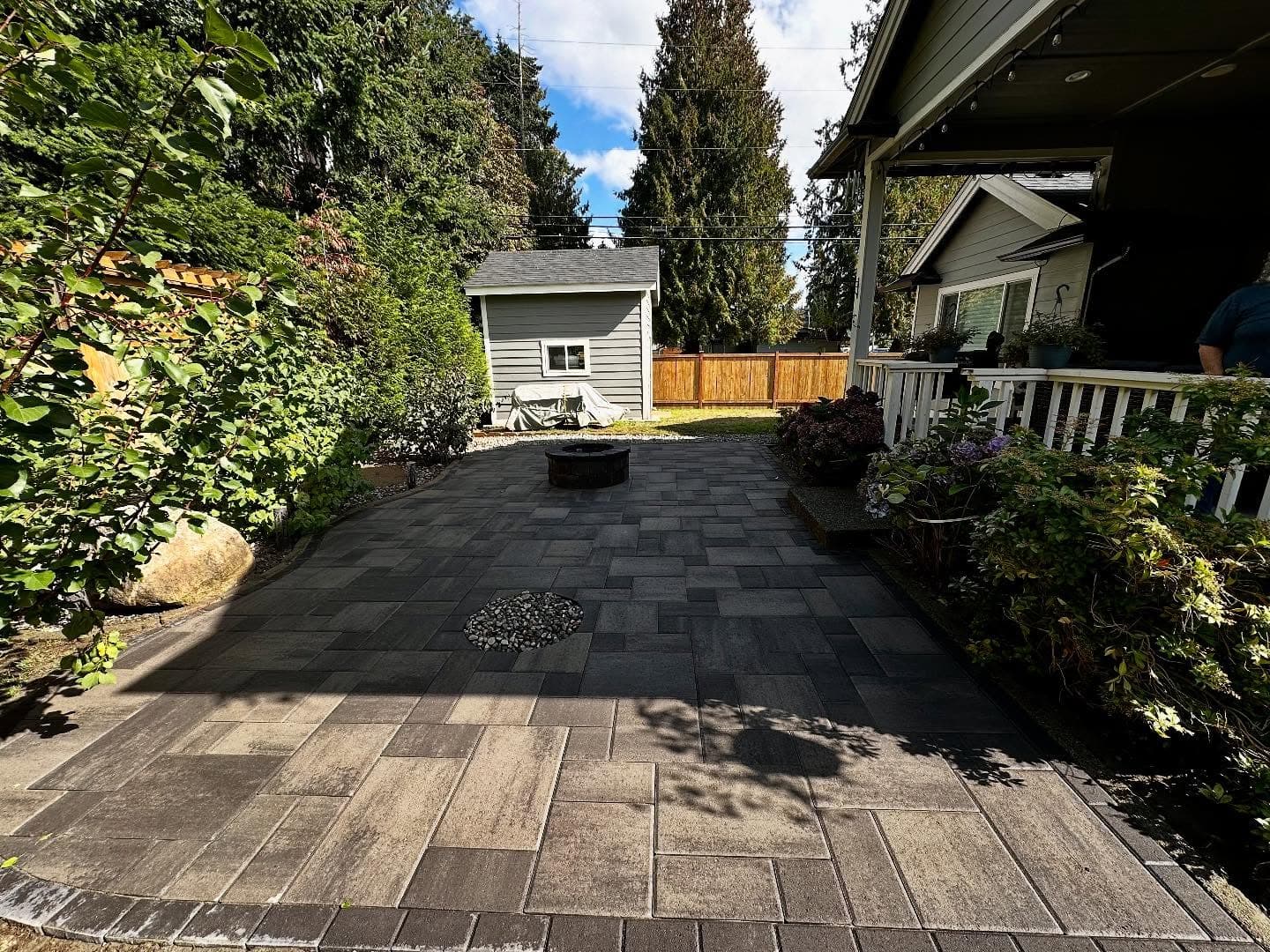
A paver patio and stamped concrete can look similar on day one, but they age differently in Western Washington. Stamped concrete is one slab that needs resealing every few years and shows cracks as permanent lines. Pavers flex with wet, shifting ground and can be lifted and relaid in sections. ND Brick Pavers builds paver patios across Tacoma and Pierce County.
We already wrote a separate comparison of pavers and plain poured concrete. This article is about the option most homeowners actually weigh against pavers: stamped concrete, which is sold as the paver look without the paver price. That pitch is partly true. Here is the part that usually gets left out.
What is stamped concrete, and how is it made?
Stamped concrete is a poured concrete slab with a pattern pressed into the surface while it is still workable. According to ConcreteNetwork, after the pour, color hardeners and release agents are applied, then the crew presses stamping mats into the surface to create the pattern. Contraction joints are cut as a final step. The finished slab is then sealed.
Two things about that process matter in our climate:
- The stamping window is short. The crew has to stamp the whole slab while the concrete is at the right stage. A large or complicated pattern takes a skilled, well-staffed crew, and the result depends on the day it was poured.
- Weather on pour day matters. Rain on fresh concrete can damage the surface before it sets. In Western Washington, scheduling a pour around the weather is a real constraint for much of the year.
A paver patio is built differently. The base is excavated and compacted, a thin bedding layer is screeded, and factory-made pavers are laid in the pattern. Rain can pause the work, but a wet day does not ruin the finished surface.
How does each one handle wet, moving ground?
This is the core difference, and it comes from what each material is.
A stamped slab is rigid. When the soil under one part of the patio settles or softens, the slab has to span the difference, and concrete is weak in tension. It cracks. Control joints exist to make those cracks happen in straight lines where they are less visible. ConcreteNetwork notes that correctly spaced control joints are what keep stamped driveways from cracking under weight.
A paver patio is thousands of separate units on a flexible base. When the ground moves slightly, the field moves with it, and the joints absorb the change.
In much of Pierce County, the ground under a patio is fine-grained soil over dense glacial till, and it can stay wet for months. That is the condition where the difference between rigid and flexible shows up.
Why do cracks look worse on stamped concrete?
Because the pattern is only on the surface. On a real paver patio, the joint between pavers is where movement is supposed to happen. On stamped concrete, the "joints" in the pattern are just impressions in a solid slab. A crack does not follow them. It cuts across the pattern, through the fake stones or bricks, and it is visible from across the yard.
ConcreteNetwork lists ways to hide cracks that do become unsightly, and it quotes a contractor who says repairing cracks can be challenging and may not fully restore the original appearance.
How much maintenance does stamped concrete need compared with pavers?
| Task | Stamped concrete | Paver patio |
|---|---|---|
| Sealing | Needed to protect color and surface; ConcreteNetwork suggests resealing every 2 to 3 years on average | Optional; done for looks, stains, or joint stability |
| Cleaning | Hose, mild detergent, push broom, or pressure washer before resealing | Sweep, hose, occasional deeper clean |
| Joints | Sawn control joints only; no sand to maintain | Joint sand needs checking and topping off over time |
| Moss | Grows on surface and in cracks | Grows in joints and on faces in shade |
| Color | Surface color can wear in traffic areas | Color runs through the paver; chips show the same color |
Pavers win on sealing. Stamped concrete wins on joints. Neither one is maintenance-free in a climate with this much moss.
Is stamped concrete slippery in the Pacific Northwest?
ConcreteNetwork notes that stamped concrete is often more slip resistant than smooth concrete because of its texture, but that it can become slippery when wet or when a film-forming sealer has been applied. In this region, that sealer sits on a shaded surface that stays damp for months and grows algae. A glossy, algae-coated sealer is slick.
Non-skid additives in the sealer help, as do heavier textures in walkways and around steps. Pavers have a textured face and joints every few inches, which add grip. Moss and algae on either surface are still a slip risk, so shaded areas need cleaning whichever you pick.
How does freeze-thaw and de-icer use affect stamped concrete?
Hard freezes are not frequent in Tacoma, but they do happen. ConcreteNetwork lists freeze-thaw damage as a disadvantage of stamped concrete, especially without the right mix design and care with de-icing salts, which can cause scaling and spalling. It also notes that a color hardener can make the surface more durable.
For a patio, the practical advice is the same either way: avoid rock salt on decorative concrete and on pavers, and keep water draining off and out of the base so there is less to freeze.
How are repairs different?
This is where the long-term difference shows.
Stamped concrete: A crack can be filled and tinted. A settled section usually has to be cut out and repoured, and matching the pattern, color, and age of the surrounding slab is difficult. Utility work under the patio means cutting the slab.
Pavers: The crew lifts the affected pavers, fixes the base, and relays the same pavers. Utility work is handled the same way. The repaired area matches because it is the same material.
One of our featured Google reviews describes this from the customer's side. The homeowner had a 25-year-old driveway that had sunk and cracked. We removed it and built a paver driveway over roughly two weeks, cleaning up at the end of each day. That kind of job is why we spend so much time on the base: the next repair should be a small one.
When is stamped concrete the right choice?
Stamped concrete is a reasonable buy when:
- The site is flat, stable, and drains well.
- You want a continuous look with no joint sand.
- The budget is fixed and up-front cost matters most.
- You are comfortable resealing on a schedule.
- You accept that cracks, if they come, will be visible.
Good stamped work from a skilled crew can look very good. If the ground is stable, it can serve you well.
When are pavers the better choice?
Pavers make more sense when:
- The soil is wet, clay-rich, or has a history of settling.
- The patio is near trees, utilities, or anything you may need to dig under later.
- You want repairs to be invisible.
- You do not want a resealing cycle.
- You want permeable options. Permeable pavers can let water pass through into a stone reservoir, which a solid stamped slab cannot do.
How do costs compare?
Stamped concrete is often less expensive to install than pavers, but the gap varies with the pattern, color work, site, and base preparation. What drives the price of either: area, excavation, base depth, soil, access, drainage, demolition of what is there now, slope, and finish. Stamped concrete also adds a resealing cycle over its life. Pavers add occasional joint sand and cleaning.
We do not publish prices. We give a free on-site quote that itemizes the base, drainage, and finish, so you can put it next to a stamped concrete bid for the same footprint.
How should you decide?
Ask three questions:
- How stable and well-drained is the ground? If you do not know, test it. A soil test answers this better than a catalog.
- How long will you own the house? A longer horizon favors the surface that can be repaired in place.
- How much maintenance will you actually do? Resealing on a schedule versus topping off joint sand.
ND Brick Pavers runs a free soil test before we design or quote. If the result says your ground is stable and stamped concrete would serve you well, we will say so. If it says the ground moves, we will show you a paver design in 3D before any work starts.
Sources
- ConcreteNetwork: Stamped concrete
- U.S. Geological Survey Open-File Report 81-517: Composition of till, Puget Lowland (PDF)
Frequently Asked Questions
Which lasts longer, pavers or stamped concrete?
Both can last a long time when built on a good base. The difference is how they age. A paver patio can be lifted and relaid in sections when the ground moves, so it can be kept in shape indefinitely. Stamped concrete is one slab, so once it cracks or settles the damage is permanent unless the section is replaced, and the surface needs regular resealing to keep its color and protection.
How often does stamped concrete need to be resealed?
ConcreteNetwork, a widely used industry resource, recommends cleaning and resealing stamped concrete every 2 to 3 years on average, depending on traffic, exposure, and weather. Pavers do not require sealing to perform; sealing them is optional and done for appearance, stain resistance, or joint stability.
Is stamped concrete slippery when wet?
The stamped texture usually gives more grip than smooth concrete, but stamped concrete can become slippery when wet or when a film-forming sealer is applied, according to ConcreteNetwork. In shaded Western Washington yards, a glossy sealer plus algae can be slick. Non-skid additives and heavier textures help. Pavers have joints and a textured face that give grip, though moss on any surface is slippery.
Can you repair cracked stamped concrete so it does not show?
Usually not completely. Cracks can be filled, colored, or disguised, but matching the pattern, color, and weathering of the surrounding slab is hard, and a contractor quoted by ConcreteNetwork says crack repair may not fully restore the original appearance. With pavers, the affected area is lifted, the base fixed, and the same pavers relaid, so the repair blends in.
Is stamped concrete cheaper than pavers?
Often it is less expensive up front, but the gap depends on the pattern, color work, site, and base preparation. What drives cost for both is area, excavation, base depth, soil, access, drainage, demolition, slope, and finish. Stamped concrete also carries a resealing cycle. Get itemized quotes for the same footprint and compare scope, not just totals.
Can pavers be installed over old stamped concrete?
Sometimes, if the slab is sound, level, and drains, using a bedding method designed for pavers over concrete. If the stamped slab cracked because the ground under it moved, putting pavers on top keeps the new surface on the same failing foundation. In most cases we recommend removing the slab and building a proper base.