
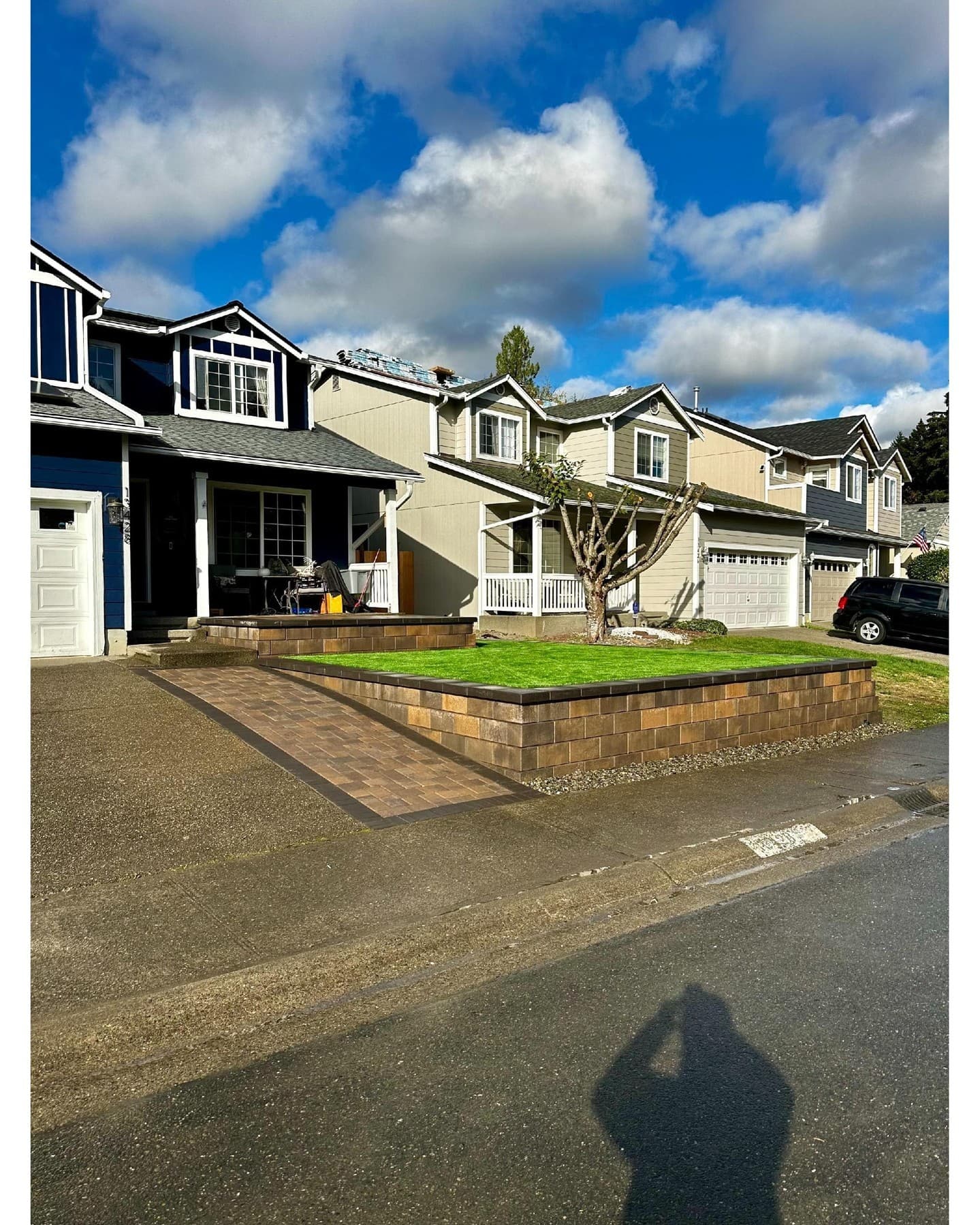
Permeable pavers can help a Tacoma project meet stormwater rules, but they do not make the rules go away. The city lists permeable pavement (BMP L633) among the low impact development practices that can earn a surface water rate reduction, and its permeable driveway detail calls for a reservoir layer and a 6-inch minimum treatment layer. ND Brick Pavers designs these systems from a soil test.
I coordinate permits on our projects, and permeable pavers are the topic where I see the most confusion. Some homeowners think they are required. Some think they cancel every stormwater requirement. Some have been told they work on any soil. None of that is quite right in Tacoma, and the details below come from the city's own documents, linked at the end.
What are permeable pavers, and how do they handle rain?
A permeable paver looks like a regular concrete paver, but it is laid with wider joints filled with small, clean stone instead of sand. Rain runs into those joints and down into a thick layer of open-graded rock underneath, where it is stored and then soaks slowly into the native soil.
The Washington Stormwater Center at WSU Puyallup describes the system as an upper "wearing layer" strong enough for vehicles and open enough to pass water, over a base layer with larger spaces that holds water temporarily. It also reports that newly installed permeable pavements can test at infiltration rates of over 200 inches per hour.
That number is the reason permeable pavers are interesting here. Sea-Tac averages about 39 inches of rain a year under NOAA's 1991 to 2020 normals, and November alone averages more than 6 inches. A standard patio sheds that water to its edges. A permeable patio takes it in.
When do Tacoma's stormwater rules apply to a home paving project?
For most single patios, they do not trigger anything beyond normal good drainage. The thresholds are project-scale:
- Tacoma requires a site development permit for new or replacement of 2,000 square feet or more of hard surface, grading of more than 50 cubic yards, or disturbance of 7,000 square feet or more of land.
- Under the city's 2021 manual, policy memo ESD22-02 applied Minimum Requirements 1 through 5 to redevelopment that results in 2,000 square feet or more of new plus replaced hard surface, or 7,000 square feet of land disturbance. Redevelopment means a site that already has 35 percent or more hard surface coverage, which describes most established Tacoma lots.
- The same memo applied Minimum Requirements 1 through 9 when redevelopment adds 5,000 square feet or more of new hard surface.
The 2026 Tacoma Stormwater Management Manual applies to applications submitted on or after July 1, 2026. The thresholds above are from the 2021 manual and the city's memo interpreting it, so confirm the current numbers for your application date with Environmental Services before you plan around them.
The practical point: a patio plus a driveway replacement plus a walkway can add up to 2,000 square feet faster than people expect, and that is the moment a permeable section starts earning its keep.
Do permeable pavers get a project out of the stormwater requirements?
Not automatically. Permeable pavement is a tool for meeting the requirements, not an exemption from them. Tacoma's permeable driveway detail tells the engineer to provide calculations per the manual to size the reservoir, which means the surface is part of the design, not invisible to it.
How a permeable surface counts toward a threshold is a question to put directly to the city for your project. Do not assume that switching to permeable pavers drops your square footage below a line.
What does Tacoma's permeable driveway detail require?
Tacoma publishes a typical detail for permeable driveways in its green stormwater infrastructure standards (Figure 017, dated September 2025). It is written for porous asphalt and pervious concrete, with a note that permeable pavers may be allowed. The notes that matter for a homeowner:
- Permeable pavers may be allowed, with a cross section that meets the manufacturer's recommendations, includes an appropriate reservoir layer, and scarifies the subgrade.
- A 6-inch minimum treatment layer is required as the manual requires.
- The subgrade is scarified at least 2 inches so water can enter the native soil instead of skating across a compacted surface.
- Run-on is limited. Water flowing onto the permeable surface from other areas should only come from fully stabilized ground, because dirty run-on clogs it.
- Geotextile is required between the permeable ballast and the sand layer, and may be required against native soil.
- A geomembrane barrier separates permeable and standard pavement where they meet, and may be required near the house per a soils professional.
- The detail applies to driveways that are flat or slope away from the house. A driveway that slopes toward the structure needs additional design.
- Soils suitability and design criteria come from BMP L633 in the stormwater manual.
The detail also recommends following the city's right-of-way design manual and APWA standards for permeable work on private property. That is a useful benchmark when you compare contractor proposals.
Will permeable pavers work on my soil?
This is the question that decides everything, and it is the one most often skipped.
Much of the Puget Lowland sits on glacial deposits. A USGS report on Seattle-area glacial soils describes the lower Vashon till as dense "hardpan" with the appearance of weak concrete, and gives a hydraulic conductivity range for till that is orders of magnitude lower than outwash sand. In practice, two Pierce County lots a few miles apart can drain completely differently depending on whether they sit on till or on outwash gravel, and you cannot tell which from the surface.
On slow soil, a permeable system can still work, but it needs a deeper reservoir or an underdrain, and an underdrain that connects to a city system has to be designed for that flow. On some lots, high winter groundwater or a shallow hardpan layer makes infiltration a poor bet. A clay-heavy yard that stays saturated from November to March is not a place to store water under a driveway.
What we look at before recommending permeable pavers:
- An infiltration test on the actual lot, not a guess from the neighborhood.
- How deep the dense layer or seasonal water sits.
- Slope of the surface and slope toward the house.
- Where water already comes from: roof downspouts, a neighbor's yard, a planting bed that will wash mulch onto the surface.
If the test says no, we will tell you, and a standard paver surface with solid drainage is the better build.
Can permeable pavers lower my Tacoma stormwater bill?
They can. Tacoma's Low Impact Development Surface Water Rate Reduction lists BMP L633 Permeable Pavement among the typical low impact development practices that can qualify.
- Mitigating one surface with LID qualifies for a one-category rate reduction.
- Mitigating all surfaces on the property qualifies for a two-category reduction.
- The rate can never go below the undeveloped rate for the property.
The process is real paperwork. You request the reduction before building, submit the design, allow city inspections, write an operations and maintenance manual, file yearly maintenance reports with Environmental Services, and sign a covenant and easement agreement. If the system is not maintained or stops working, the city can revoke the reduction. Worth it for some homeowners, not for others.
How do you maintain permeable pavers in the Pacific Northwest?
The Washington Stormwater Center's homeowner guidance is short and practical:
- Keep dirt off it. Never dump soil, compost, or bark directly on the surface. Put a tarp down first.
- Redirect run-on. Water carrying dirt from beds or regular pavement will clog the joints.
- No pesticides or herbicides. The pavement is filtering stormwater.
- Avoid sanding it in snow. If sand goes down in an emergency, vacuum it out after the melt.
- Moss is normal here. If water still soaks in, moss is cosmetic. Sweep it out in dry weather, use a weed burner, or have it vacuumed.
- Deep clean at least once or twice a year, which may mean hiring someone with a vacuum sweeper.
The test is easy: watch it in a heavy rain. If the water disappears into the surface, it is working. If water sheets across to a low corner, the joints are likely clogged.
Permeable pavers or a standard paver surface: how do you decide?
Choose permeable when:
- The project is near a stormwater threshold and the soil infiltrates.
- You have a low spot or a driveway that currently dumps water toward the house or the street.
- You want the rate reduction and are willing to keep up the maintenance.
Choose a standard paver surface with engineered drainage when:
- The infiltration test is poor or winter groundwater is shallow.
- The area will collect heavy debris from trees, beds, or construction.
- The surface slopes toward the house and there is no room to manage it.
What should you ask a contractor about permeable pavers?
- Will you run an infiltration test on my lot before recommending this?
- What is the reservoir depth, and how was it sized?
- What stone goes in the joints and the base, and is there a treatment layer?
- Where does the water go if the soil cannot take it all?
- How does this affect my permit and stormwater thresholds?
- What maintenance will I need to do, and how often?
How ND Brick Pavers approaches permeable pavers
We run a free soil test before we design anything, and that test decides whether permeable is the right call. When it is, we design the reservoir and joints for your soil and tell you what the city will want to see. When it is not, we say so. Our office is in Yelm, and our crews build across Tacoma and Pierce County.
Sources
- City of Tacoma: Permeable Driveway typical detail, Figure 017 (September 2025)
- City of Tacoma: Low Impact Development Surface Water Rate Reduction tip sheet
- City of Tacoma: Stormwater Management Manual tip sheet
- City of Tacoma: Stormwater Permits and Manuals (2026 SWMM)
- City of Tacoma Environmental Services Policy Memo ESD22-02
- City of Tacoma: What Requires a Permit
- Washington Stormwater Center / WSU Extension: Permeable Pavements homeowner guide
- Washington Department of Ecology: Stormwater manuals
- USGS Open-File Report 00-228: Geotechnical Properties for Landslide-Prone Seattle Area Glacial Deposits
- NOAA NCEI: 1991-2020 monthly normals, Seattle-Tacoma International Airport
Frequently Asked Questions
Are permeable pavers required in Tacoma?
Not for a typical backyard patio. Tacoma's stormwater Minimum Requirements start applying at project thresholds, such as 2,000 square feet of new plus replaced hard surface under the redevelopment rules that went with the 2021 manual. The 2026 manual applies to applications from July 1, 2026, so confirm the current threshold with the city. Once a project crosses a threshold, permeable pavement is one of the low impact development tools that can help meet the requirements, if the soil and site support it.
Do permeable pavers work on clay or glacial till?
Sometimes, with a deeper reservoir layer or an underdrain, and sometimes not at all. Dense glacial till drains far more slowly than sandy outwash soil. Tacoma's permeable driveway detail points designers to BMP L633 for soils suitability, and an infiltration test on your actual lot is the only honest way to answer this.
Can permeable pavers lower my Tacoma stormwater bill?
Possibly. Tacoma's Low Impact Development Surface Water Rate Reduction lists permeable pavement (L633) as a qualifying practice. Mitigating one surface can earn a one-category rate reduction and mitigating every surface a two-category reduction. You must request it before building, allow inspections, file yearly maintenance reports, and sign a covenant and easement with the city.
Do permeable pavers grow moss?
Yes, moss is common on permeable pavements in the Pacific Northwest. The Washington Stormwater Center says moss is not a problem as long as water still soaks in. If you want it gone, sweep it out in dry weather or have the surface vacuumed. Avoid pesticides and herbicides, because the pavement is filtering stormwater into the ground.
Can I use regular polymeric sand in permeable paver joints?
No. A permeable paver system works because its joints and base are open to water. Sealing the joints with polymeric sand, or filling them with fine sand and dirt, closes the path the water is supposed to take. Permeable joints are filled with small, clean, open-graded stone.
How long do permeable pavers keep draining?
As long as the joints stay open. New permeable pavements can test at infiltration rates over 200 inches per hour, according to the Washington Stormwater Center, but sediment and debris slowly fill the pore space. Keeping dirt off the surface and cleaning it at least once or twice a year is what keeps the rate up.