
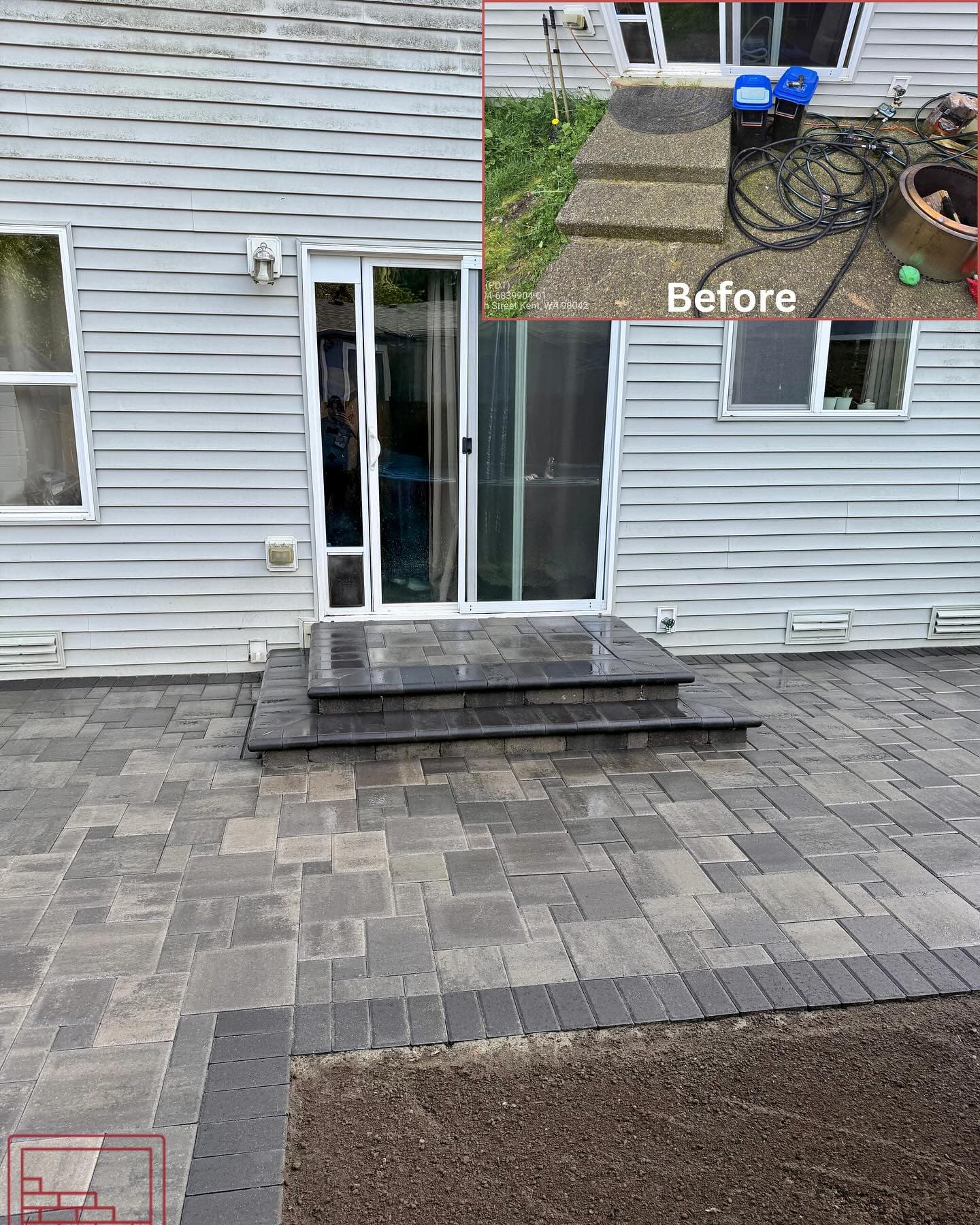
Pavers sink when the layer under them moves: a thin or poorly compacted base, wet subgrade, bedding sand washing out, a failed edge restraint, or roots. Small dips can be fixed by lifting, re-basing, and resetting the same pavers. This guide shows how to read the sinking pattern, how to do a small repair yourself, and when the problem is big enough to need a crew.
The good news about sinking pavers is that they are repairable. Unlike a cracked slab, a paver surface can be taken apart, fixed underneath, and put back with the same pavers. The bad news is that the fix only lasts if you find the actual cause. Re-leveling pavers over a base that is still failing is a repair you will do twice.
What causes pavers to sink?
There are six common causes. They leave different patterns, which is how you tell them apart.
| What you see | Most likely cause |
|---|---|
| Ruts in wheel paths on a driveway | Base too thin or not compacted for vehicle loads |
| A dish-shaped dip in a patio or walkway | Soft spot in subgrade or thin base in that area |
| Sinking that gets worse in winter | Wet subgrade losing strength |
| Edges dropping and joints opening along the border | Missing or failed edge restraint |
| A straight-line dip across the surface | Settlement over a backfilled utility or drain trench |
| Sinking near a downspout or at the bottom of a slope | Concentrated water softening soil and moving sand |
| A bump, then later a dip, near a tree | Roots lifting, then decaying or being cut |
How do you tell base failure from a surface problem?
Press on the area and look closely.
- A single paver rocks but the area around it is flat: usually a joint or bedding problem. Easy fix.
- A group of pavers is low but firm: the base under them settled once, and may be stable now.
- The area feels soft or moves underfoot, or water pumps out of the joints when you step on it after rain: the subgrade or base is wet and weak. This is a base failure.
- Mud or fine soil appears in the joints: fine soil is migrating up from the subgrade into the base. The base is contaminated.
A simple test is to lift one paver at the edge of the low area and look. Clean, firm, gravel-like base under a thin sand layer is a good sign. Muddy, soft material, or several inches of sand, is not.
Why does a paver base fail?
A paver base fails when it cannot carry the load or cannot stay dry enough to keep its strength.
Industry installation guidance calls for base material placed in lifts no thicker than about 4 inches, each compacted, and for pedestrian areas and residential driveways to reach at least 95% to 98% of standard Proctor density, depending on which guide you follow. The same guidance says weak or saturated soils may not reach that density at all without stabilization or drainage. A base that was dumped in one thick layer, or compacted once over soft soil, will settle under use.
Driveways show this first. A base built for patio foot traffic will rut under vehicle wheels, especially where cars turn or stop.
Why does water cause so much paver sinking in Western Washington?
Our subgrade is often fine, silty soil over very dense glacial till. A U.S. Geological Survey report notes that north of Olympia, till is the most common surface and near-surface material, describing it as compact deposits that resemble concrete. On job sites, that dense layer tends to hold water in the softer soil above it.
That creates three problems for pavers:
- Saturated soil is weaker. A subgrade that is firm in August can be soft in January, and the base settles into it.
- Fines pump into the base. Under load, wet fine soil pushes up into the gravel, slowly turning a clean base into a muddy one that settles and drains worse.
- Water moves sand. Runoff through open joints and along failed edges carries bedding sand away, leaving voids under the pavers.
That is why many sinking problems here show up near downspouts, at the low side of a patio, and in the wet season. If you do not fix the water, the repair will not hold.
How does a failed edge restraint make pavers sink?
Edge restraint is the border that holds the paver field together. Industry guidance describes it as providing the lateral resistance that keeps pavers interlocked. Without it, pavers at the edge slowly spread outward, joints open, sand drains out, and the edge rows drop.
Common causes:
- No edge restraint was installed.
- The restraint was spiked into bedding sand or soil instead of into the compacted base.
- The base stops at the paver edge instead of extending past it, so the restraint has nothing to sit on.
- A plastic restraint was broken by a mower or vehicle tire.
Edge sinking is common, and it is one of the most preventable failures.
Can tree roots make pavers sink?
Roots usually lift pavers first. Over time, as roots are cut, die, or decay, they leave voids that the base and pavers settle into. You may see a hump near a tree followed years later by a dip.
The fix depends on the tree. Sometimes a root barrier and a base repair solve it. Sometimes the honest answer is that a large, healthy tree and a flat paver surface will keep competing. Talk with an arborist before cutting major roots.
How do you fix sinking pavers yourself?
For a small, isolated dip on a patio or walkway with a sound base, this is the process:
- Mark the area a little larger than the low spot so the repair blends in.
- Remove the pavers. Pry out the first one with two flat screwdrivers or a paver extractor, then lift the rest by hand. Number them or photograph the pattern.
- Scrape off the bedding sand and look at the base.
- Fix the base, not the sand. Add base material to the low area and compact it with a hand tamper or a rented plate compactor, in thin layers, until it matches the surrounding grade.
- Re-screed bedding sand to an even thickness, typically about 1 to 1.5 inches, matching the surrounding area.
- Reset the pavers in the original pattern, tap them level, and compact them in.
- Refill the joints with sand, compact, and top off.
Check with a straightedge across the repair and the surrounding pavers. If water is the cause, fix the water at the same time, or the dip will come back.
When should a crew handle sinking pavers?
Call a contractor when:
- The sinking is large, or there are multiple low spots.
- The driveway is rutting in the wheel paths.
- Pavers are sinking along the house foundation or toward it, which can send water to the house.
- The base is muddy or soft when you lift a paver.
- The area has already been repaired once and sank again.
- Edge restraint has to be replaced along a long run.
- There is a drainage problem to solve, such as a downspout, a low side, or a slope.
These repairs need excavation, base replacement, plate compaction, and sometimes a geotextile and drainage outlet. A crew with the right equipment can usually finish this faster and with better compaction than hand tools allow.
What does a professional sinking paver repair include?
On a typical repair, our crew:
- Lifts the affected pavers and stacks them for reuse.
- Removes contaminated base and soft subgrade where needed.
- Adds geotextile on wet subgrade so fines stay out of the new base.
- Rebuilds the base in compacted lifts.
- Corrects slope and adds a drainage outlet if water caused the failure.
- Installs or replaces edge restraint anchored into the base.
- Re-screeds bedding sand, resets the original pavers, compacts, and refills the joints.
What drives the cost of a repair: the size of the area, how deep the base problem goes, whether drainage work is needed, access for equipment, and how many pavers need replacing. We give a free on-site quote after we see it.
How do you prevent pavers from sinking?
- Build the base for the load and the soil, not a default depth.
- Compact in thin lifts.
- Use geotextile on wet or fine-grained soil.
- Extend the base past the paver edge and anchor the edge restraint into it.
- Send downspouts and surface water away from the paver surface.
- Keep joints full.
ND Brick Pavers starts every new project with a free soil test so the base matches the ground. If your pavers are sinking, a site visit will tell you whether it is a quick reset or a base and drainage repair.
Sources
- CMHA Tech Note PAV-TEC-002-22: Construction of Interlocking Concrete Pavements (PDF)
- ConcreteNetwork: Concrete paver installation overview
- U.S. Geological Survey Open-File Report 81-517: Composition of till, Puget Lowland (PDF)
Frequently Asked Questions
Why are my pavers sinking?
Almost always because something under them moved. The most common causes are a base that was too thin or poorly compacted, a base that stays wet and soft, bedding sand washing out through open joints or a failed edge, a missing or loose edge restraint, settling over a backfilled trench, or tree roots pushing and then decaying. The pattern of the sinking usually tells you which one.
Can I fix sinking pavers myself?
A small, isolated dip on a patio or walkway is a reasonable DIY repair: lift the pavers, add and compact base material where it is low, re-screed the bedding sand, reset the pavers, and refill the joints. Large areas, driveway ruts, sinking along a foundation, or areas that keep sinking after repair point to a base or water problem that is usually a job for a crew with compaction equipment.
Can you just add sand under sinking pavers?
Adding a little bedding sand to bring one or two pavers back to level can work if the base below is sound. Using thick sand to fill a real low spot does not work, because sand is not a structural layer. The low spot is in the base, and extra sand will compress, wash out, and sink again. The fix is to correct the base.
How do you fix pavers sinking along the edge?
Edge sinking and spreading usually mean the edge restraint failed or was never installed, or the base stops short of the paver edge. The repair is to lift the edge rows, extend and compact the base past the paver edge, install a proper restraint anchored into the base, and reset the pavers. Simply re-leveling the edge pavers without a restraint will fail again.
Do sinking pavers mean the whole patio needs to be replaced?
Usually not. One of the advantages of pavers is that a failed section can be lifted, the base repaired, and the same pavers relaid. Full replacement makes sense when the whole base is undersized or contaminated with mud, when sinking is widespread, or when the original pavers are badly damaged. A site check tells you which situation you are in.
Why do pavers sink near downspouts and in the wet season?
Because concentrated water softens the soil under the base and can carry bedding sand away through joints and edges. In Western Washington, soil under a patio can stay saturated for months, and a downspout adds a roof's worth of water to one spot. Pavers that sink only in winter, or only near a downspout, are telling you to fix the water first.